
How to Determine Your Ring Size for the Perfect Fit
Finding your ring size means measuring your finger's circumference. A simple strip of paper or a printable sizer will work. The key is consistency—measure at the right time of day, when your hands are at a neutral temperature.
Why an Accurate Ring Size is Essential
Choosing a ring is personal. The experience depends on a perfect fit. Guesswork has no place here; an accurate measurement ensures comfort and security.
A ring that’s too tight restricts circulation. A ring that’s too loose is at constant risk of being lost.
When the fit is precise, the ring becomes a natural extension of your hand. It honors the craftsmanship, allowing the piece to sit exactly as the designer intended.
Beyond the Measurement
Finding your ring size requires more nuance than a single measurement. Precision is vital, as several factors can affect the outcome.
- Daily Fluctuations: Your fingers change size throughout the day. They are typically smaller in the morning and swell later due to heat, exercise, or diet.
- Knuckle Size: For many, the knuckle is wider than the base of the finger. The ring must be large enough to slide over the knuckle but snug enough to not spin once in place.
- Band Width: A wider band occupies more space, creating a tighter feel. For wide bands, you may need to go up a half-size or more compared to a delicate one.
A precise fit is the soul of minimalist design. A perfectly fitted ring elevates the entire aesthetic, becoming one with the hand.
Measuring correctly from the start avoids the cost and effort of resizing. For minimalist styles, our insights on gold-plated silver rings offer a starting point. Now, let’s explore practical ways to measure at home.
How to Measure Ring Size at Home
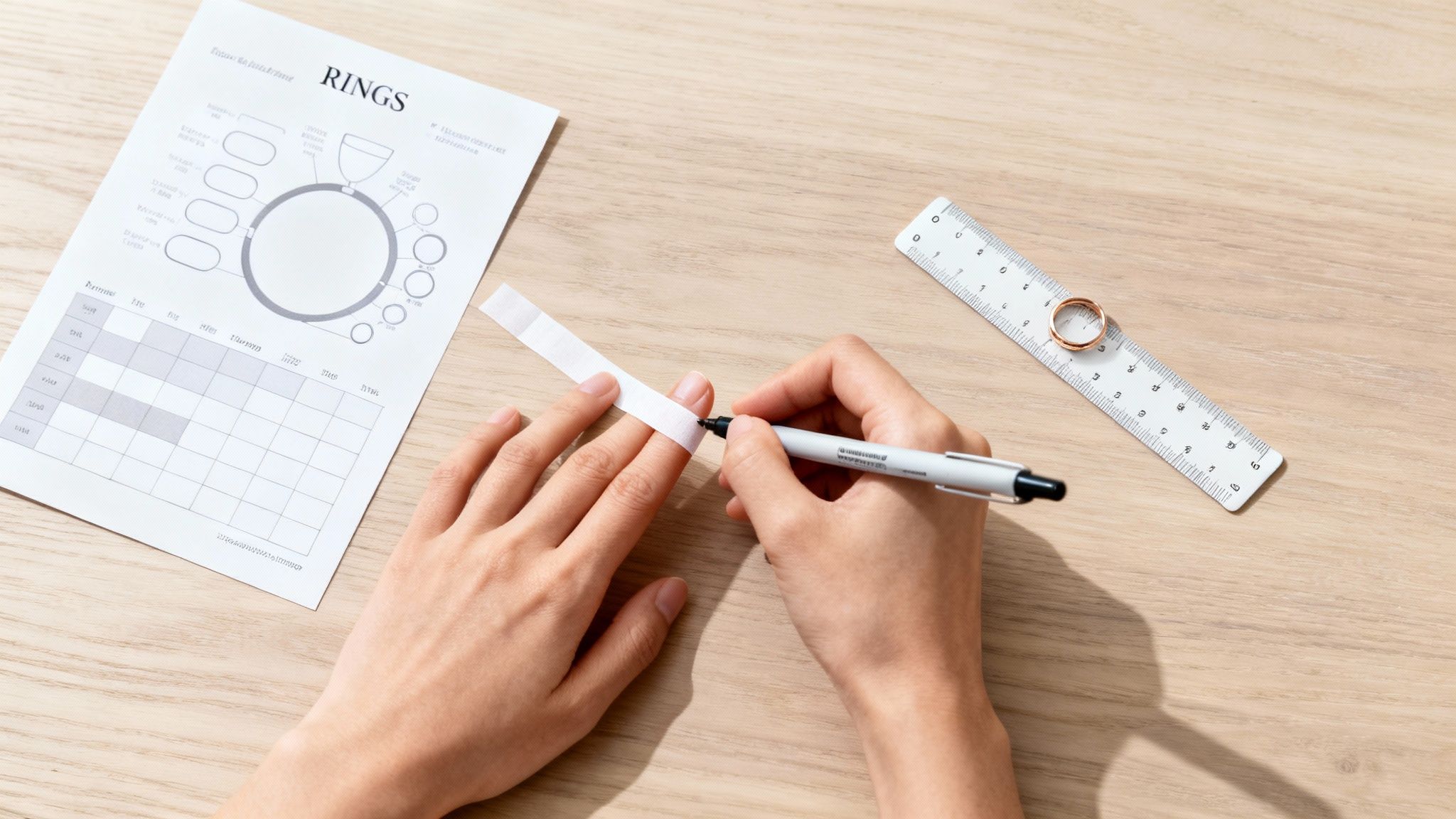
You can achieve a precise measurement at home without visiting a jeweler. The details matter.
We offer three trusted methods. Each is designed to provide a reliable size, ensuring your ring fits perfectly upon arrival.
Method 1: Paper or String
This common DIY method uses materials you already have. It measures your finger's circumference, which can be converted to a standard ring size. Accuracy depends on your care.
Cut a thin, non-stretch strip of paper or string. Dental floss is an excellent choice due to its strength and lack of give.
Wrap the material around the base of your finger. It should be snug enough not to fall off but loose enough to slide over your knuckle. Mark the exact point where the end overlaps.
Lay the marked paper or string flat against a ruler. Measure the length from the end to your mark in millimeters for the most accurate result. This number is your finger's circumference.
Method 2: Printable Ring Sizer
A printable ring sizer offers a more structured tool. These are widely available online as downloadable PDFs.
The critical step is verifying the print scale. Most guides include a reference line that must measure a specific length, often 30 millimeters. Check this with a ruler. An incorrect scale will yield a wrong size.
Printable sizers come in two forms:
- A cut-out sizer: This tool forms a loop, like a zip tie. Slide it onto your finger and pull it snug to read your size directly.
- A ring chart: This is a sheet of circles corresponding to different ring sizes. Use it by placing an existing ring over the circles until you find a perfect match with the inner edge.
Accuracy is non-negotiable. When using a printable sizer, always double-check the print scale. A printer setting that is off by even 3-5% can result in a measurement that is off by a full ring size.
Method 3: Measure an Existing Ring
This is the most reliable at-home method, provided you have a ring that already fits the intended finger perfectly. You will measure the ring's internal diameter—a fixed, dependable measurement.
Place the ring on a flat surface. Use a ruler with millimeter markings to measure the distance straight across the center of the ring, from one inner edge to the other. Do not include the metal of the band itself.
Once you have the internal diameter in millimeters, use a conversion chart to find the corresponding ring size. For ultimate precision, a digital caliper removes all guesswork.
For a detailed walkthrough, see our guide on how to properly measure your finger for a ring.
Expert Tips for Accurate Measurement
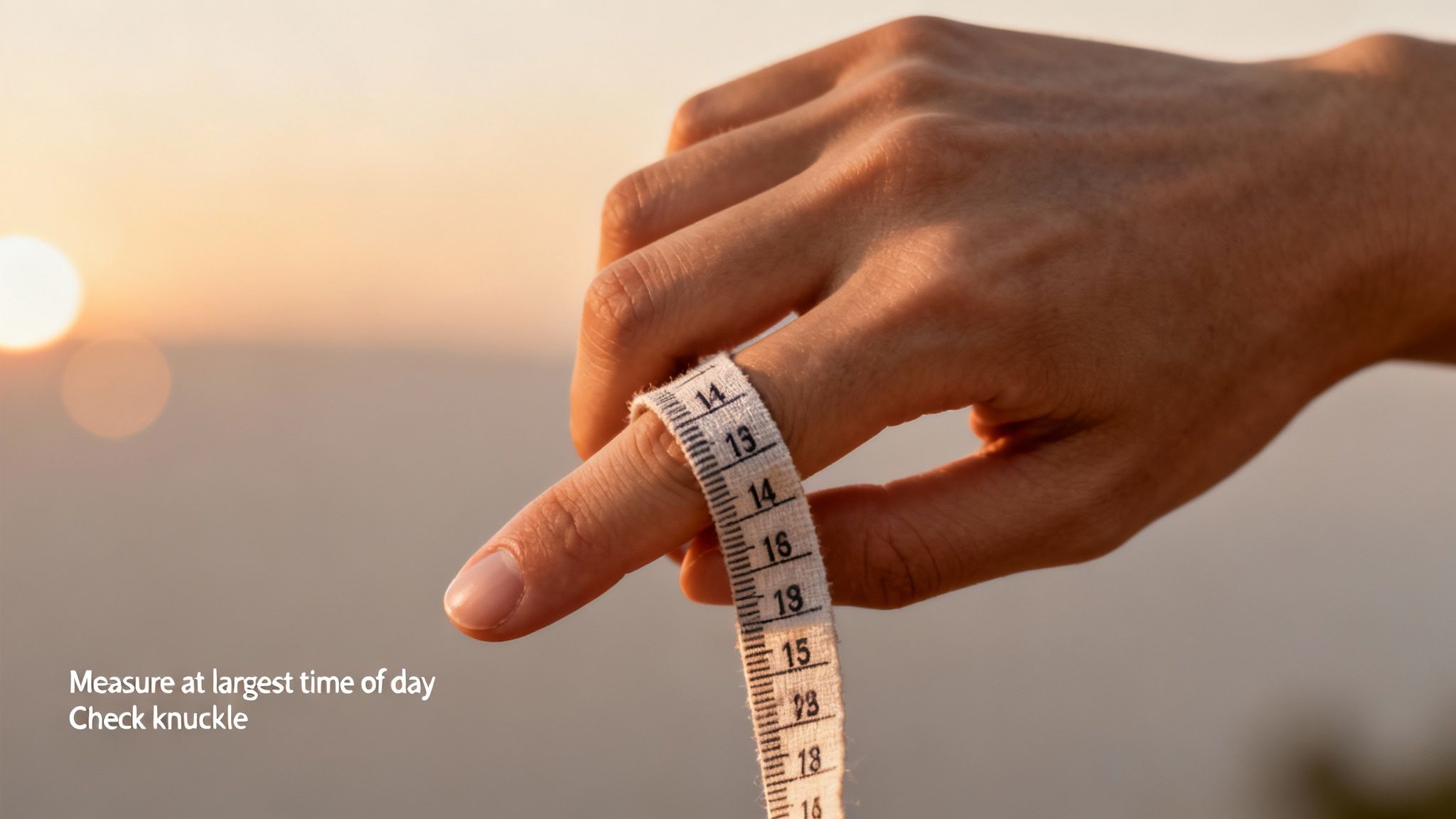
Knowing the methods is only the beginning. Subtle details are what guarantee a perfect fit. A careful measurement can be inaccurate if taken at the wrong time or without considering the ring's design.
These are the professional insights that turn a good estimate into a confident purchase.
Time of Day Matters
Your fingers are not a constant size. They are often smaller in the morning and swell throughout the day due to activity, diet, and temperature.
For the most reliable reading, measure your finger in the late afternoon or evening. At this time, your finger is likely at its largest, ensuring the ring remains comfortable all day.
A ring should accommodate the natural rhythm of your body. Measuring in the evening accounts for maximum finger size, preventing the discomfort of a ring that becomes too tight.
This simple adjustment is crucial. Fingers can swell by up to 1.25mm in warm conditions, affecting up to 25% of ring fittings. Encouraging evening measurements can reduce online returns by as much as 15%. This insight applies to other fitted items like S925 earrings. For more, see these average ring sizes and fitting tips.
Account for Your Knuckle
A common mistake is measuring only the base of the finger. If your knuckle is wider than where the ring will sit, a base measurement is useless. The ring will not go on.
The ring must clear your knuckle. This requires two measurements: one around the base of your finger and another around the widest part of your knuckle.
The ideal size is typically between these two numbers. This ensures the ring is large enough to slip on but will not spin loosely once in place.
The Impact of Band Width
Ring design plays a significant role in fit. The width of the band is a critical detail often overlooked in at-home sizing.
A wider band—5mm or more—covers more skin, creating more friction and a tighter feel. For these rings, you will almost always need to go up half a size. For a very thin, delicate band, your standard size should be correct.
Understanding International Ring Sizing
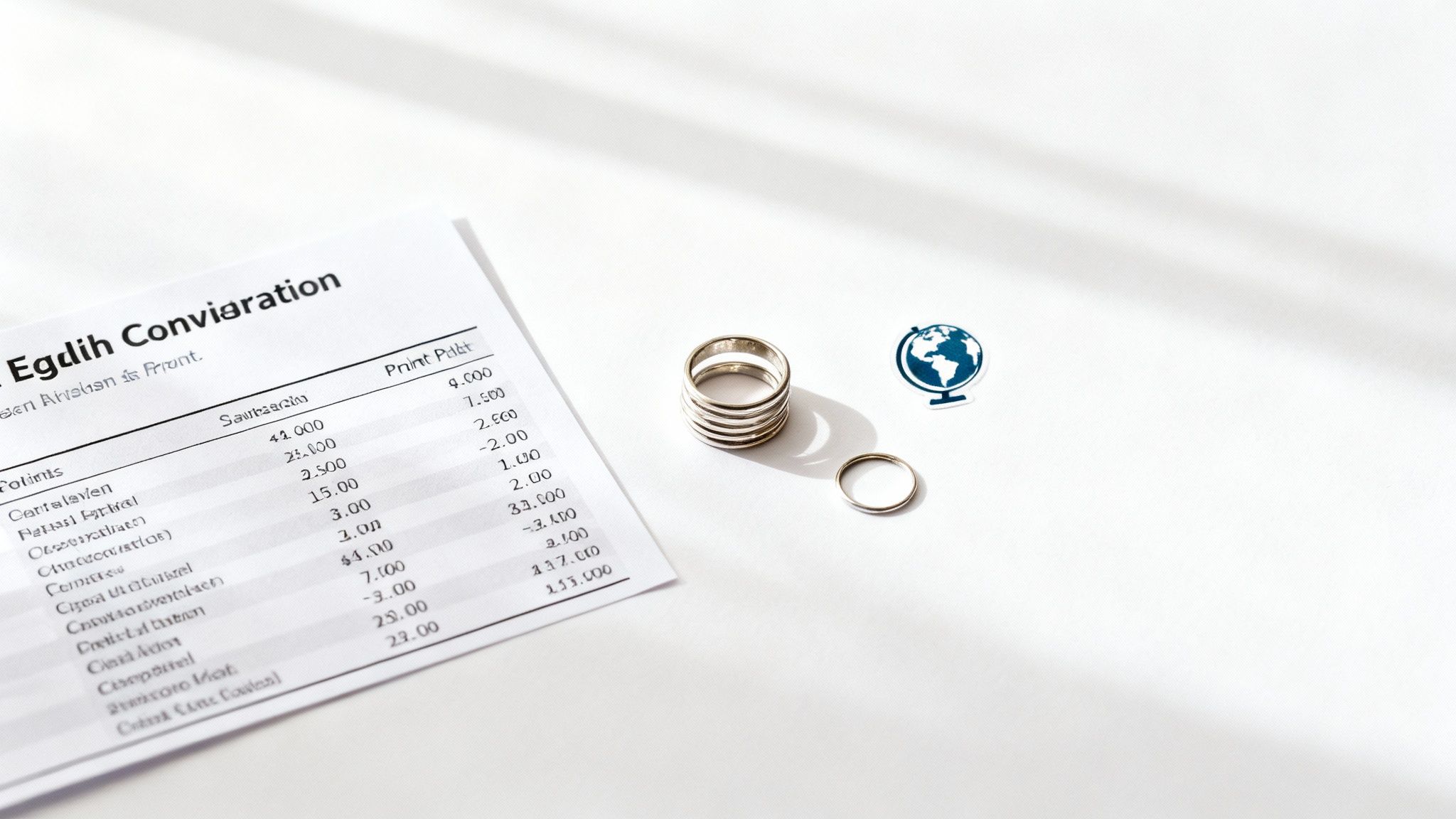
You have your measurement. The next step is understanding what it means. Online shopping provides access to global designers, but they all use different sizing systems.
A "size 7" in the US is not a "size 7" elsewhere. This discrepancy contributes to an estimated 30-40% of online ring returns. Understanding international conversions is key to a successful purchase.
Global Sizing Systems
Navigating international ring sizes requires a clear reference. Each region has a unique system.
Here is a summary of the major systems:
- US & Canada: A numerical scale, often including half and quarter sizes for a precise fit.
- UK & Australia: An alphabetical system (A, A½, B, etc.).
- France & Europe: A direct system where the size equals the ring's inner circumference in millimeters. A size 54 is 54mm.
- Japan: A numerical system that does not align with US or European standards.
Without translation, you are guessing. A US size 7 can be a UK size N½, a Japanese size 13, or a European size 54.
Simple Conversion
You do not need to memorize these systems. A reliable conversion chart is your essential tool. It translates your known measurement—such as circumference in millimeters—into its equivalent across all major sizing standards.
A good conversion chart provides clarity. It allows you to focus on the design, not the numbers.
For example, a finger circumference of 54.4 mm translates to:
- US Size 7
- UK Size N½
- European Size 54
This tool provides the confidence to purchase from any international artisan. We have created a comprehensive ring size chart to eliminate guesswork.
International Ring Size Conversion Chart
| Diameter (mm) | Circumference (mm) | US & Canada Size | UK & Australia Size | France & Europe Size | Japan Size |
|---|---|---|---|---|---|
| 14.1 | 44.2 | 3 | F | 44 | 4 |
| 14.9 | 46.8 | 4 | H½ | 46.5 | 7 |
| 15.7 | 49.3 | 5 | J½ | 49 | 9 |
| 16.5 | 51.9 | 6 | M | 52 | 11 |
| 17.3 | 54.4 | 7 | N½ | 54.5 | 14 |
| 18.1 | 57.0 | 8 | P½ | 57 | 16 |
| 19.0 | 59.5 | 9 | R½ | 59.5 | 18 |
| 19.8 | 62.1 | 10 | T½ | 62 | 20 |
| 20.6 | 64.6 | 11 | V½ | 64.5 | 23 |
| 21.4 | 67.2 | 12 | Y | 67 | 25 |
| 22.2 | 69.7 | 13 | Z+1 | 69.5 | 27 |
Always use this chart to cross-reference your measurement with the sizing system of the retailer.
Common Sizing Mistakes to Avoid
Getting your ring size right seems simple, yet common pitfalls can lead to an inaccurate measurement. A small error can result in a ring that is either too tight or too loose.
The most frequent mistake is using a measuring tool that stretches. Materials like yarn or rubber bands will give an artificially small measurement, leading to a painfully tight ring. Use a material with zero give, such as dental floss or a paper strip.
Another major oversight is forgetting the knuckle. The ring must be able to slide over it. Always ensure the size you choose can clear this widest part of your finger.
A perfect fit is a balance. The ring should be snug enough not to fall off but loose enough to slide over the knuckle with minimal effort. If it spins freely at the base, it’s too large.
Body and Environmental Factors
Your fingers are not static; they swell and shrink. Measuring your finger when your hands are cold is a common blunder. Cold causes fingers to contract, and a ring sized then will feel too tight once you warm up.
Measure toward the end of the day. This is when fingers are typically at their largest, ensuring a comfortable fit from morning to night.
Sizing issues are responsible for 25-35% of all jewelry returns. The culprit is often a measurement that failed to account for the knuckle. Always re-measure if it has been a while, as lifestyle factors also play a role.
This is especially important when stacking multiple rings. Explore our collection of minimalist rings for inspiration. By avoiding these common errors, you can measure with confidence.
Frequently Asked Sizing Questions
Final questions often arise even after careful measurement. Here are clear answers to ensure you choose your next ring with complete confidence.
What is the most accurate at-home sizing method?
The most reliable method is measuring an existing ring that fits the intended finger perfectly. Use a digital caliper to measure the ring's internal diameter. This eliminates the potential for error that comes with flexible materials.
If you don't have a suitable ring, a printable sizer is the next best option. However, you must first verify its print scale with a physical ruler.
Is my ring size permanent?
No. Your ring size is a current measurement, not a fixed number. It fluctuates with temperature, hydration, and activity.
Long-term changes are also normal, often tied to:
- Weight changes
- Pregnancy
- Aging, which can alter knuckle size
Re-measure your finger if it’s been several years since your last purchase or after significant life changes.
Your body changes, and so does your ring size. Re-measuring before you buy is the best practice to ensure a perfect fit.
Are my ring fingers the same size?
Almost never. The fingers on your dominant hand are typically larger, usually by about half a size. This is due to greater use, which builds slightly more muscle and bone density.
It is essential to measure the specific finger on the specific hand where the ring will be worn.
What does a perfect fit feel like?
The ideal fit is a balance of security and comfort. The ring should slide over your knuckle with slight resistance, perhaps requiring a gentle twist.
Once on, it should feel snug at the base of your finger, not tight. You should be able to spin it, but it should not feel loose enough to fall off. If you need further assistance, please reach out to our support team.
At Taton.shop, we believe the perfect ring begins with a perfect fit. Discover a piece that feels made for you. Shop the Taton.shop ring collection now.