
Improving Ecommerce Conversion Rates for Fashion Brands
Improving e-commerce conversion rates means turning more browsers into buyers. This isn't guesswork. It's a deliberate process of analyzing data, understanding user behavior, and methodically refining the customer journey. The goal is to make buying from you effortless.
Establishing Your Data-Driven Baseline
Before making any changes, you must understand your current performance. This data-driven baseline is your starting point. Without it, you can't measure whether your adjustments are effective.
Look past vanity metrics like total traffic. Focus on Key Performance Indicators (KPIs) that signal store health. For a fashion brand like Taton.shop, this means tracking numbers that show real purchase intent and customer loyalty.

Defining Core Fashion KPIs
Pinpoint the actions that matter. This includes not just final sales, but the micro-conversions leading to a purchase. They provide a clear view of what works.
Essential metrics to monitor:
- Add to Cart Rate: What percentage of visitors add products to their cart? A low rate may indicate issues with product pages, pricing, or discoverability.
- Checkout Completion Rate: How many shoppers who start checkout finish it? A high drop-off often points to unexpected shipping costs, a complex form, or a lack of trusted payment options.
- Return Customer Rate: What percentage of customers buy again? This KPI reflects product quality and the overall customer experience.
- Average Order Value (AOV): How much does a customer spend per order? Tracking AOV helps identify buying trends and opportunities for upselling.
Pro tip: Segment your data. A visitor from an Instagram ad behaves differently than one from a direct search. Identify which channels deliver high-intent customers.
Setting Up Meaningful Goals in GA4
With KPIs defined, make them trackable in Google Analytics 4 (GA4). This isn’t just data collection; it's building a framework to measure what matters.
For example, create conversion events for key products. Track how many people view an oversized tee made from a premium 250 GSM fabric, then add it to their cart. Our guide on what GSM means in fabric can provide more context.
This detailed tracking reveals what resonates. If S925 silver rings get many views but few "add to carts," it's a signal. Perhaps shoppers need better sizing information or clearer material details.
By building this analytical foundation, every subsequent change can be measured against your baseline. This disciplined approach is the core of improving ecommerce conversion rates, ensuring your work drives measurable growth.
Auditing Your Customer's Digital Journey
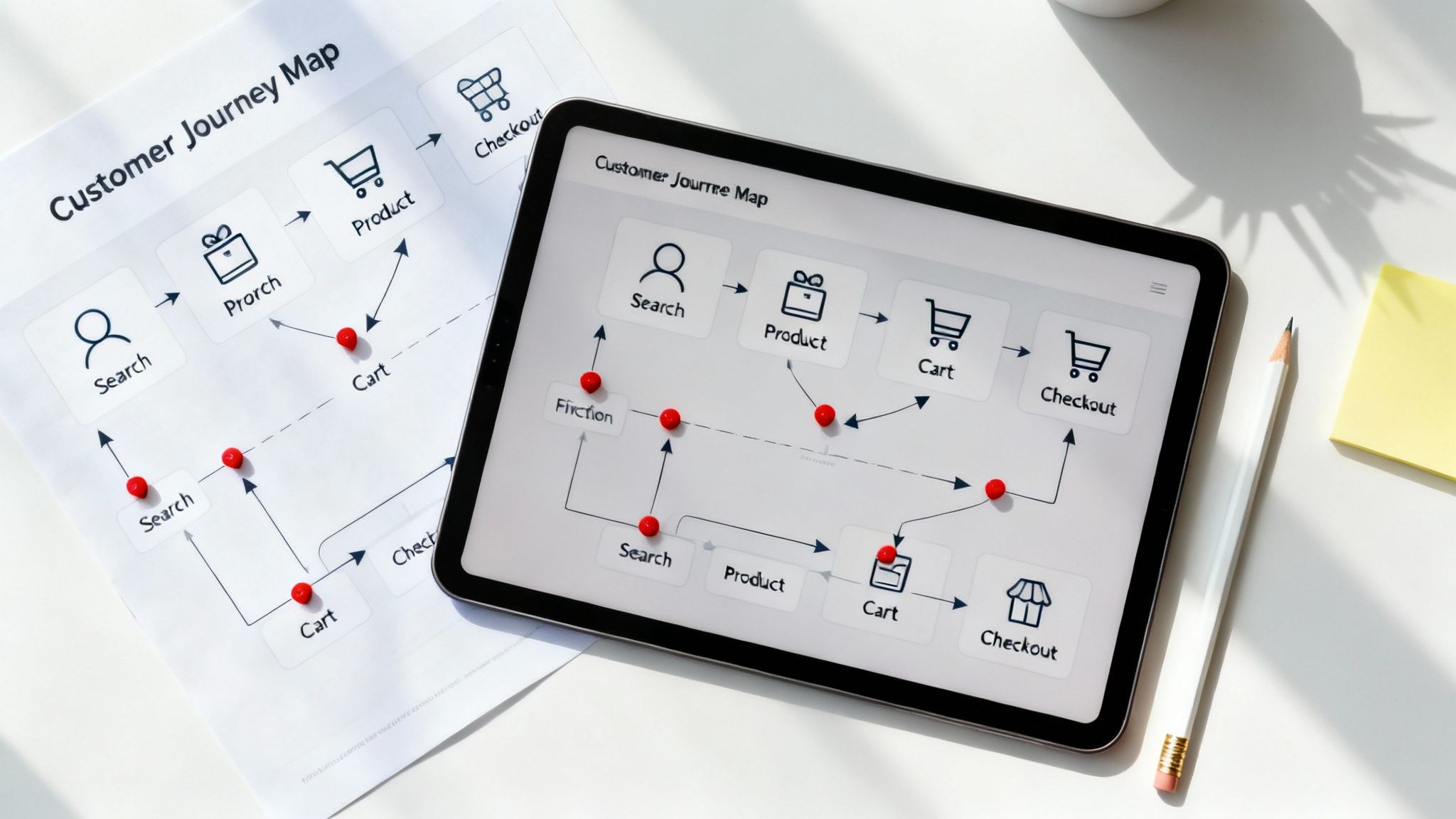
A great product isn't enough. The path to purchase must be equally well-designed. Walk through your own store as a customer to identify every point of friction.
Your website is a conversation. A confusing interface is a poor first impression, ending the dialogue before it begins. The goal is to remove every obstacle between "I like this" and "I'm buying this."
Uncovering Hidden Friction Points
Friction isn't always a "404 Error." It's often small annoyances that erode a shopper's confidence. Your job is to find these subtle conversion killers.
Start with navigation and search. Is your main menu logical or cluttered? Can a visitor easily distinguish between "oversized tees" and "crop-tops"? Confusion here causes hesitation.
Test your search bar. Does a query for "silver earrings" differentiate between solid S925 silver and plated accessories? Irrelevant results are a dead end.
A UX audit is an exercise in empathy. Understand the why behind a click and anticipate where a customer might get stuck.
Analyzing The Collection And Filtering Experience
The collection page is a critical moment. If your filtering system is poor, you will lose customers. A frustrating filter experience is a primary reason for site abandonment.
Evaluate your filters. For a store like Taton.shop, shoppers expect:
- Material: Quickly find 100% cotton.
- Size: Filters must be accurate and easy to use. Our comprehensive Ukrainian clothing size guide shows how to build better guides.
- Price Range: A slider makes large collections manageable.
- Color: Show a visual palette, not just text.
Empower your customers, don't overwhelm them. A great filtering system provides control and guides them smoothly to their desired product.
Mapping The Path To Purchase
Trace the entire path from start to finish. Click an ad, land on a product page, add to cart, browse elsewhere, then attempt checkout.
Document every click. Note awkward page loads or confusing button text. Is there clear visual confirmation after adding to cart? Each step is a potential leak in your conversion funnel.
Mapping this journey turns abstract data into a concrete list of fixes. This builds an effortless and enjoyable shopping experience.
Crafting Product Pages That Convert
The product page is the final conversation before a purchase. Here, brand style meets product detail. You must sell an experience and a promise of quality.
A high-converting product page for a brand like Taton.shop requires three elements: stunning imagery, compelling copy, and clear sizing information. They must work together to eliminate hesitation.
Evocative Imagery: The Digital Fitting Room
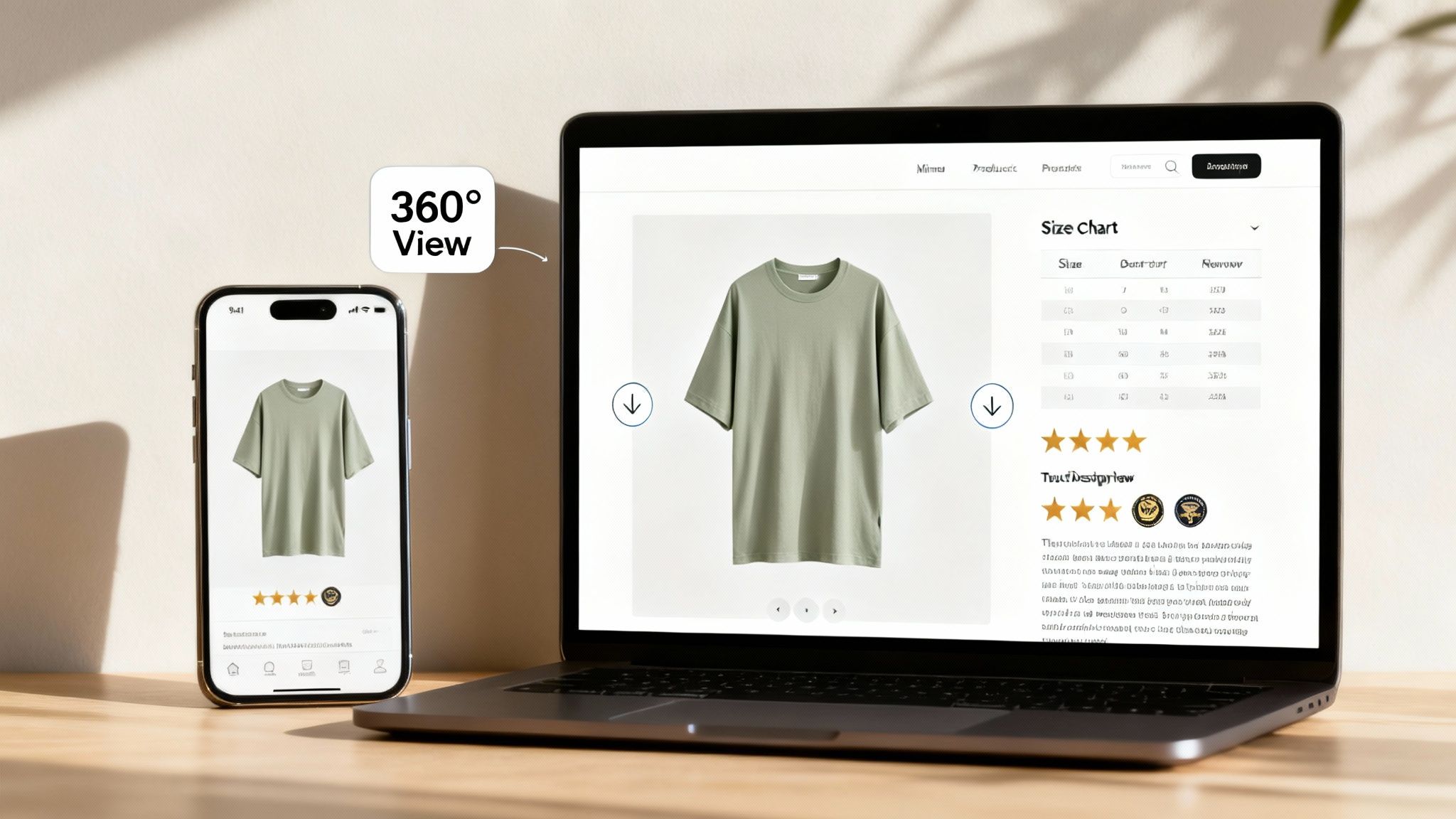
Online, your photos are the fitting room. They must convey texture, weight, and craftsmanship through a screen. Basic images are no longer sufficient.
A full suite of visuals is essential for improving ecommerce conversion rates.
- High-Resolution Detail Shots: Show the weave of a 250 GSM cotton tee or the clasp on an S925 silver necklace. These details signal premium quality.
- Lifestyle Context Photos: Show products in real-world settings. An oversized sweatshirt worn on a Kyiv street is more compelling than one on a plain background.
- 360-Degree Views or Video: Allow shoppers to see every angle. A short video showing how a t-shirt drapes can be the final push needed for a purchase.
These visuals bridge the gap between browsing online and holding an item.
Product photography shouldn't just show a product; it should make the customer imagine their life with it.
Persuasive Copy: Selling a Feeling
Your product description is your salesperson. It must create an emotional connection while delivering key details. Generic descriptions fail to create desire.
Frame features as benefits. A "100% cotton" t-shirt offers breathable, all-day comfort. Learn more about the best quality cotton t-shirts in our detailed article. For a broader strategy, this practical guide to improving ecommerce conversion rates in fashion is an excellent resource.
Ensure your copy is scannable. Use short sentences and bullet points.
- Materials: Be specific. "S925 Silver with 18K Gold Plating."
- Fit & Style: Use descriptive terms like "Relaxed oversized fit."
- Care Instructions: Provide simple advice like "Machine wash cold, lay flat to dry."
This layered approach serves both browsing and detail-oriented shoppers.
Trust-Building Fit and Sizing Guides
Sizing is the biggest challenge in online fashion. Fit anxiety is a top reason for abandoned carts. A detailed, easy-to-use sizing guide is a powerful tool for building trust.
Effective sizing guides offer multiple reference points.
Key Elements for a High-Converting Fashion Product Page
| Element | Objective | Taton.shop Example |
|---|---|---|
| Detailed Measurements | Provide precise product dimensions in cm. | "Size M: Chest - 58 cm, Length - 72 cm" |
| Model Specifications | Show the product on a real person. | "Model is 175 cm tall and wears a size M" |
| Fit Recommendations | Give contextual advice. | "For a classic fit, size down. For the intended oversized look, take your usual size." |
| Size Conversion | Include international or familiar sizing. | "EU 38 / UK 10 / US 6" |
This level of detail empowers customers, boosts their confidence, and makes them far more likely to click "Add to Cart." This focus on clarity is fundamental to high-performing product pages.
Designing a Frictionless Checkout Experience
The checkout is the final step. Any friction—a confusing form, a surprise fee—can lose the sale. This last step must be the easiest part of the shopping experience.
A great checkout is engineered for speed, transparency, and trust. Every element must serve a purpose, removing obstacles and reassuring the shopper.
Simplify and Streamline the Process
Complexity is the enemy of checkout conversion. There is a direct link between the number of form fields and cart abandonment. Ask only for essential information.
Review your checkout form field by field. Do you need a "Company Name" for a T-shirt order? Can you use smart defaults, like auto-populating the shipping address from billing information?
Implement immediate improvements:
- Offer Guest Checkout: Forcing account creation is a known conversion killer. Make guest checkout the most visible option.
- Trim Down Your Forms: Stick to the essentials: name, address, email, payment info. Each removed field increases completion rates.
- Aim for a Single-Page Layout: A single-page checkout reduces clicks and shows the customer how close they are to finishing.
A seamless checkout respects the customer's time and makes the final step effortless.
Build Trust with Transparency and Diverse Payment Options
Unexpected costs are the most common reason for cart abandonment. Be upfront about all costs, especially shipping, from the very beginning.
Show shipping options and prices on the cart page. A progress bar (e.g., Shipping > Payment > Confirmation) guides the customer and manages expectations.
Offer payment methods your customers trust, especially for the Ukrainian market.
- Localize Your Payments: Integrate services like NovaPay or offer payment through Privat24.
- Include the Standards: Visa, Mastercard, and digital wallets like Apple Pay and Google Pay are non-negotiable.
- Show Your Security: Display SSL certificates and other security badges clearly.
Personalization at checkout can also make a significant impact. Data shows a tailored experience can boost conversion rates significantly. You can learn more about how personalization impacts conversion rates for a deeper understanding.
By engineering a simple, transparent, and secure checkout, you remove the final barriers to a sale and transform potential doubt into a smooth confirmation.
Optimizing for Mobile and Building Social Proof
For a modern fashion brand, your mobile website is your main storefront. The mobile experience is no longer optional; it is the bedrock of your conversion strategy.
Simultaneously, trust is your most valuable currency. Shoppers need validation from other people. Social proof turns happy customers into your most effective advocates.

Engineering a Seamless Mobile-First Experience
"Mobile-first" means designing the entire journey for someone using their thumb. Every tap and scroll must feel natural and effortless.
Data shows over 75% of retail site visits happen on smartphones. While desktops may have slightly higher conversion rates, a slick mobile site closes that gap. Explore global e-commerce conversion benchmarks to see these trends.
Focus on these key areas for mobile performance:
- Blazing-Fast Page Speed: Mobile users are impatient. A one-second delay can significantly reduce conversions. Compress images and optimize code.
- Thumb-Friendly Navigation: Buttons and links must be large enough to tap easily. Provide adequate space around clickable elements.
- Simplified Forms: Keep forms as short as possible. Use autofill and one-click payment options like Apple Pay or Google Pay.
Your mobile site must be designed for action. Guide users from discovery to purchase with the fewest taps possible.
Harnessing the Power of Authentic Social Proof
Social proof is the principle that people follow the actions of others. In ecommerce, this translates directly to trust. Seeing that others have bought and loved a product reduces hesitation.
Customer reviews provide unfiltered answers to shopper questions: How does the 250 GSM tee feel? Does the oversized fit look good? Are the S925 silver earrings as delicate as they appear?
Placing authentic feedback on your product pages is a critical step in improving ecommerce conversion rates.
Integrating User-Generated Content and Reviews
Weave reviews into your product story. Displaying ratings and testimonials builds instant credibility.
Put social proof to work effectively:
- Showcase Detailed Reviews: Encourage customers to leave specific feedback on fit and material. A platform like Judge.me can automate this. See how other top Ukrainian clothing brands use customer feedback.
- Feature User-Generated Content (UGC): Ask customers to post photos wearing your products. Displaying these real-world images is incredibly powerful.
- Highlight "Bestseller" Badges: This simple visual cue signals that a product is popular and a safe choice.
By combining a flawless mobile experience with the trust built by social proof, you create a powerful conversion engine. You meet customers on their phones and give them the confidence to buy.
Earning Trust with Clear Policies and Strong Brand Signals
In ecommerce, trust is everything. It's the invisible currency that convinces someone to click "buy." You must intentionally build it with clear policies and consistent signals that remove doubt.
Your website is a series of promises. Being transparent about shipping, returns, and contact information is non-negotiable. It shows you respect the customer and creates a secure environment for purchase.
Make Your Policies Crystal Clear and Customer-Friendly
Uncertainty kills sales. If a customer can't find your shipping or return policy, they will leave. Make this information impossible to miss and easy to understand.
Use a dedicated page for policies and link to it from your footer and product pages. Use simple, direct language, avoiding legal jargon.
- Shipping Transparency: Name your delivery partners (like Nova Poshta), provide realistic delivery estimates, and show all costs upfront.
- A No-Hassle Return Process: Clearly state your return window (e.g., 14 days), item conditions, and the exact steps to follow. This proves you stand behind your products.
A customer-first return policy is a powerful trust signal. It minimizes perceived risk, making customers more likely to buy.
Weave Trust Signals Throughout Your Site
Your site needs visual cues that signal credibility from the moment a visitor arrives. These elements create an immediate impression of a professional and secure business.
Visible contact information is essential. A phone number, email, and physical address show there are real people behind the website. This accessibility is reassuring.
Security badges are critical, especially at checkout. Logos from trusted payment providers confirm that financial information is safe.
Finally, your brand story matters. Sharing your mission builds an emotional connection. See how we approach this by reading what sustainable fashion means to us.
Authentic reviews are another key component. According to Ruler Analytics, referral traffic has a strong conversion rate. For fashion, specific reviews about material feel or fit can be the final push a customer needs.
Common Questions About Conversion Rate Optimization
Let's address some frequent questions about conversion optimization with practical answers to sharpen your strategy.
What Is a Good Ecommerce Conversion Rate?
A good conversion rate is often cited as 2% to 4%, but this figure is misleading. It varies dramatically by industry and product type.
Instead of focusing on industry averages, aim to improve your own baseline month over month. This is the true measure of success.
The only benchmark that truly matters is your own past performance. Aim for consistent, incremental gains.
How Much Does Product Page Design Really Matter?
It matters immensely. Your product page is your final pitch. Its design can either secure the sale or drive customers away. Clear images, transparent pricing, and genuine reviews are non-negotiable.
Your descriptions must focus on benefits, answering the customer's silent question: "How will this improve my life?" And with most traffic coming from mobile, a perfect mobile experience is essential.
What Are Some Quick Wins for Boosting Purchase Intent?
To get more people to buy quickly, reduce friction and build trust. Offer free shipping or a clear money-back guarantee to lower the customer's perceived risk.
Simplify your checkout process. It must be effortless. Offer a guest checkout option and minimize the number of required fields. These small changes can yield significant results.
For a comprehensive overview, these 10 proven ecommerce conversion rate optimization tips provide an excellent roadmap.
Discover a curated selection of minimalist apparel and accessories designed to elevate your style. At Taton.shop, we focus on premium materials and timeless design, offering everything from oversized tees to S925 silver jewelry. Explore the collection at https://taton.shop.
