
Your Perfect Fit: The MM Ring Size Guide
A perfect fit comes down to precision. Forget confusing international charts. At its core, ring sizing is about one thing: the exact mm ring size, measured by inner circumference or diameter. This is the universal language of jewelers.
Understanding it ensures the minimalist S925 silver ring you want will feel made for you.
Why Millimeters Ensure A Perfect Fit
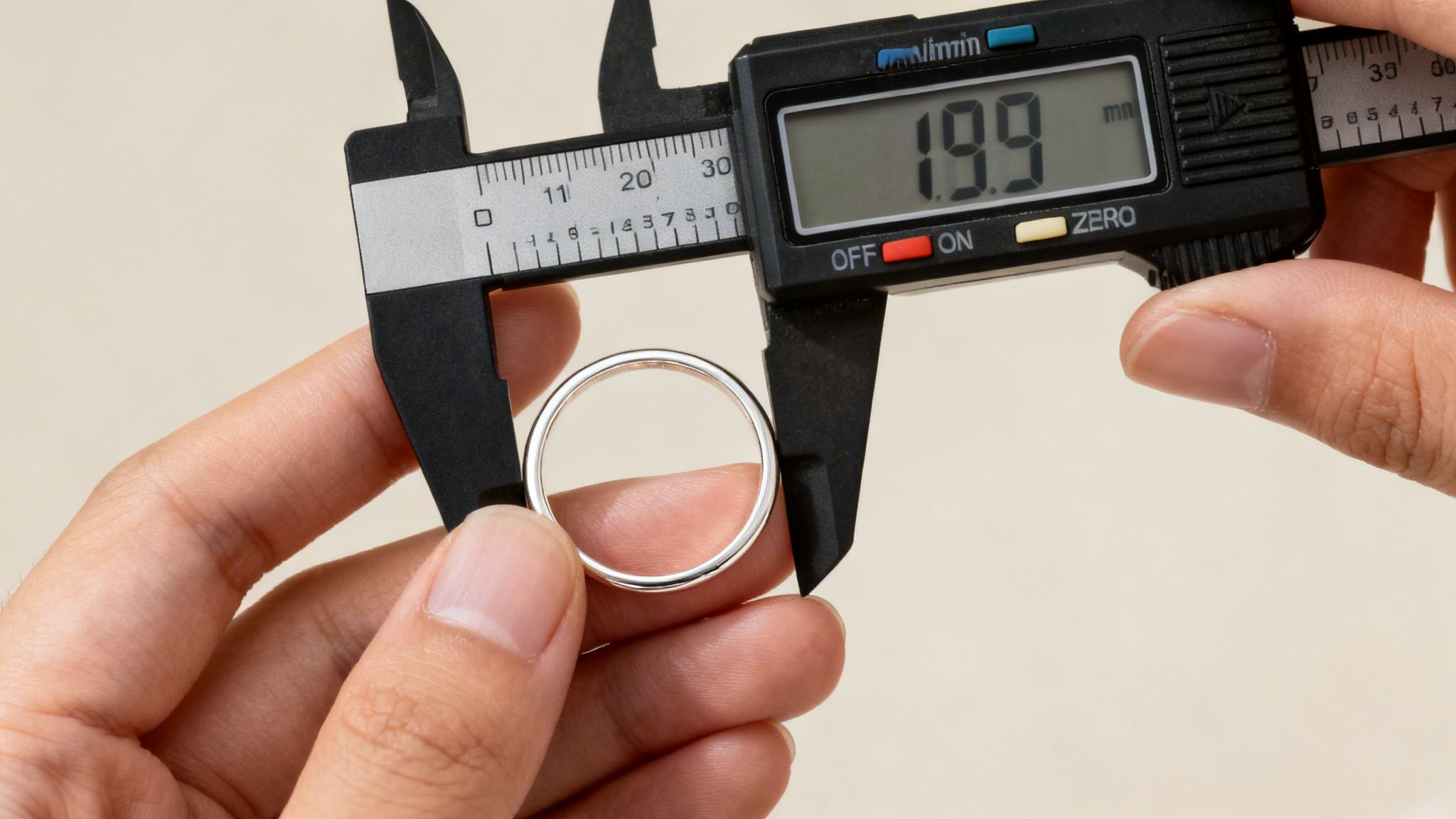
Shopping for jewelry online demands accuracy. A vague size chart can turn an exciting purchase into a frustrating return. Measuring your ring size in millimeters (mm) is the most reliable method.
It cuts through the noise by focusing on two key measurements:
- Inner Circumference: The distance around the inside of the ring band.
- Inner Diameter: The straight line across the center of the ring, from one inner edge to the other.
Grasping these metrics is the key to a consistently comfortable fit. It guarantees your chosen ring will feel secure, whether it is a delicate band or a more substantial piece.
The Universal Language of Sizing
The millimeter system is powerful because it is direct. There is no ambiguity. European sizing (ISO 8653) is a prime example: the ring size is the inner circumference in millimeters. A size 52 ring has a 52 mm circumference.
This clarity reduces misfit-related returns in e-commerce by up to 20%. For you, an EU size 57 is a direct, verifiable measurement. Learn more about how ring sizes are standardized.
Focusing on the exact mm ring size sidesteps conversion errors between US, UK, and other systems. You are measuring the ring’s physical dimensions—the most reliable data you can have.
This knowledge empowers you to shop confidently from anywhere. Whether adding a stacking ring from the Taton.shop collection or selecting a gift, the precise millimeter measurement turns a guess into a guarantee. It transforms the process into an exact science.
Quick Guide to Common MM Ring Sizes
This reference table shows popular sizes and their millimeter equivalents. Use it to quickly convert a known size into raw data.
| US Size | UK Size | EU Size (Circumference in mm) | Diameter (mm) |
|---|---|---|---|
| 5 | J ½ | 49 | 15.7 |
| 6 | L ½ | 52 | 16.5 |
| 7 | O | 54 | 17.3 |
| 8 | Q | 57 | 18.1 |
| 9 | R ¾ | 60 | 18.9 |
| 10 | T ½ | 62 | 19.8 |
The EU size directly reflects the circumference, making it a clear and trusted system for online jewelers.
How To Measure Your Ring Size at Home
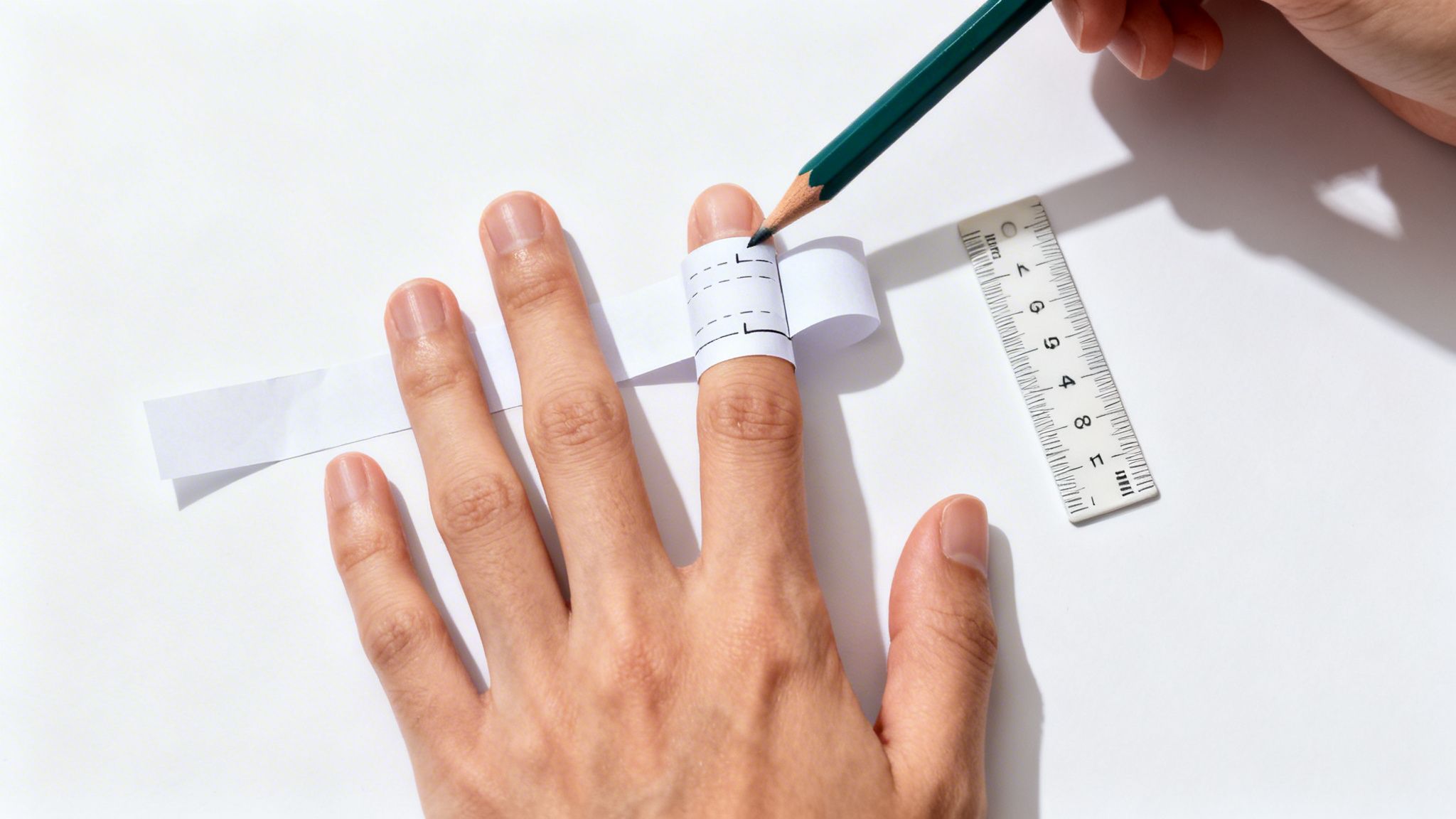
You don't need a jeweler to find your accurate mm ring size. A few household items provide a precise measurement, removing the guesswork from online shopping.
We will cover two proven methods: measuring your finger's circumference and using the diameter of a ring you already own.
The Paper Strip Method: Measuring Circumference
This classic technique is ideal if you do not have a ring to measure. It provides a direct circumference in millimeters, which corresponds to European sizing.
You will need a strip of paper, a pen, and a ruler with millimeter markings.
-
Prep: Cut a straight, thin strip of paper, about 10 cm long and 0.5 cm wide. Do not use string, as it can stretch and cause an inaccurate reading.
-
Wrap: Wrap the paper snugly around the base of your finger. It should be firm but loose enough to slide over your knuckle.
-
Mark: Use a pen to mark the exact point where the paper overlaps.
-
Measure: Unroll the paper and lay it flat against your ruler. The distance from the end of the strip to your mark is the circumference. For example, a 54 mm measurement equals a size 54 EU.
A common mistake is pulling the paper too tight. The fit should feel like a real ring—secure, not constricting.
The Existing Ring Method: Finding Diameter
If you own a ring that fits perfectly, this is often the most reliable way to find your size. It already accounts for your knuckle and personal fit preference.
You will need the ring and a ruler with clear millimeter markings. A digital caliper is even better.
Expert Tip: Using a comfortable ring is one of the most dependable ways to find your size. It automatically accounts for your knuckle size and preference.
First, ensure the ring is perfectly round. Older rings can become misshapen, which will skew your measurement. Also, consider the band's width. A wide band fits tighter, so try to use a reference ring with a similar width to the one you want from Taton.shop.
To measure:
- Lay the ring over the millimeter side of your ruler.
- Measure directly across the center of the ring.
- Read the distance from one inner edge to the opposite inner edge. Do not include the thickness of the band.
That number is the inner diameter. A measurement of 17.3 mm, for example, can be used with a conversion chart to find the perfect size.
Navigating Ring Size Conversion Charts
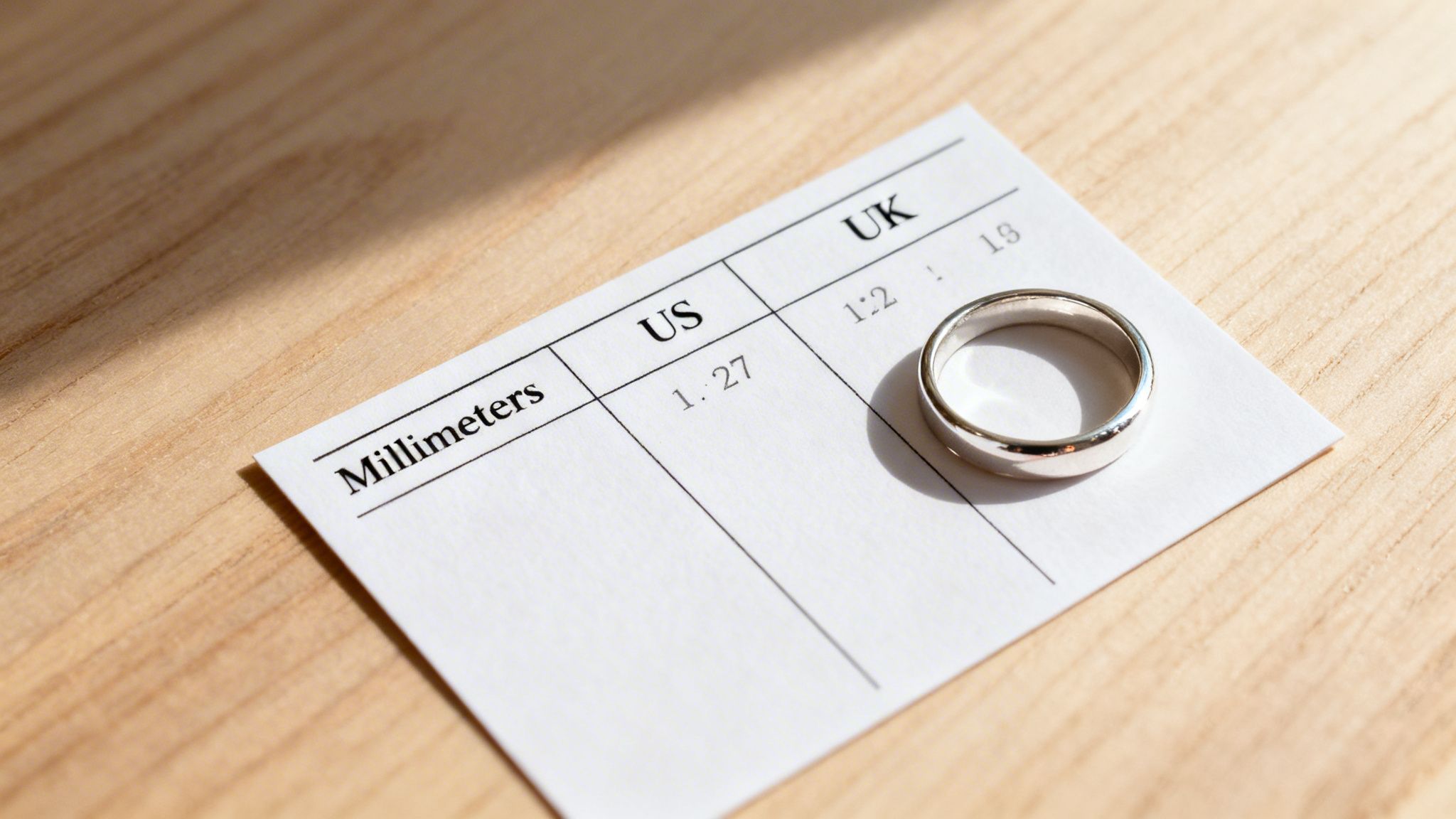
Once you have your measurement, you can understand any ring size, anywhere. Your mm ring size is the universal constant for translating between different sizing scales.
It can seem confusing. European sizing is direct—a size 54 means a 54 mm circumference. The US system uses a numerical scale, while the UK system uses letters. Your millimeter measurement cuts through this confusion.
Making Sense of Global Standards
A detailed conversion chart is your best tool. It takes your raw measurement—a 17.3 mm inner diameter or a 54.4 mm circumference—and shows you its equivalent in US, UK, or European terms.
Think of it as a Rosetta Stone for jewelry. You are no longer guessing; you are making a data-driven decision. This is critical when buying online.
The core idea is simple: The physical size of your finger does not change. International sizes are just different labels for that same measurement.
Some context helps. The most common ring size sold globally is a US 7, which translates to a 54.4 mm circumference. Since the average woman's ring size is between US 5 and US 8, this makes sense. Providing clear conversion guides helps online jewelers reduce returns by up to 30%. You can learn more about essential ring sizes and industry trends.
Comprehensive Ring Size Conversion Chart
Use this table as your go-to reference. Find your measurement in millimeters to see your size across major international systems.
If your measurement falls between two sizes, it is almost always better to choose the larger one, especially for a wider band.
| Inner Circumference (mm) | Inner Diameter (mm) | US & Canada Size | UK & Australia Size | EU Size |
|---|---|---|---|---|
| 49.3 | 15.7 | 5 | J ½ | 49 |
| 50.6 | 16.1 | 5.5 | L | 51 |
| 51.9 | 16.5 | 6 | L ½ | 52 |
| 53.1 | 16.9 | 6.5 | M ½ | 53 |
| 54.4 | 17.3 | 7 | O | 54 |
| 55.7 | 17.7 | 7.5 | P | 56 |
| 57.0 | 18.1 | 8 | Q | 57 |
| 58.3 | 18.5 | 8.5 | R | 58 |
| 59.5 | 18.9 | 9 | R ¾ | 59 |
| 60.8 | 19.4 | 9.5 | T | 61 |
| 62.1 | 19.8 | 10 | T ½ | 62 |
| 63.4 | 20.2 | 10.5 | V | 63 |
Keep this chart handy to shop for rings worldwide with total confidence.
Beyond the Numbers: Factors That Affect Fit
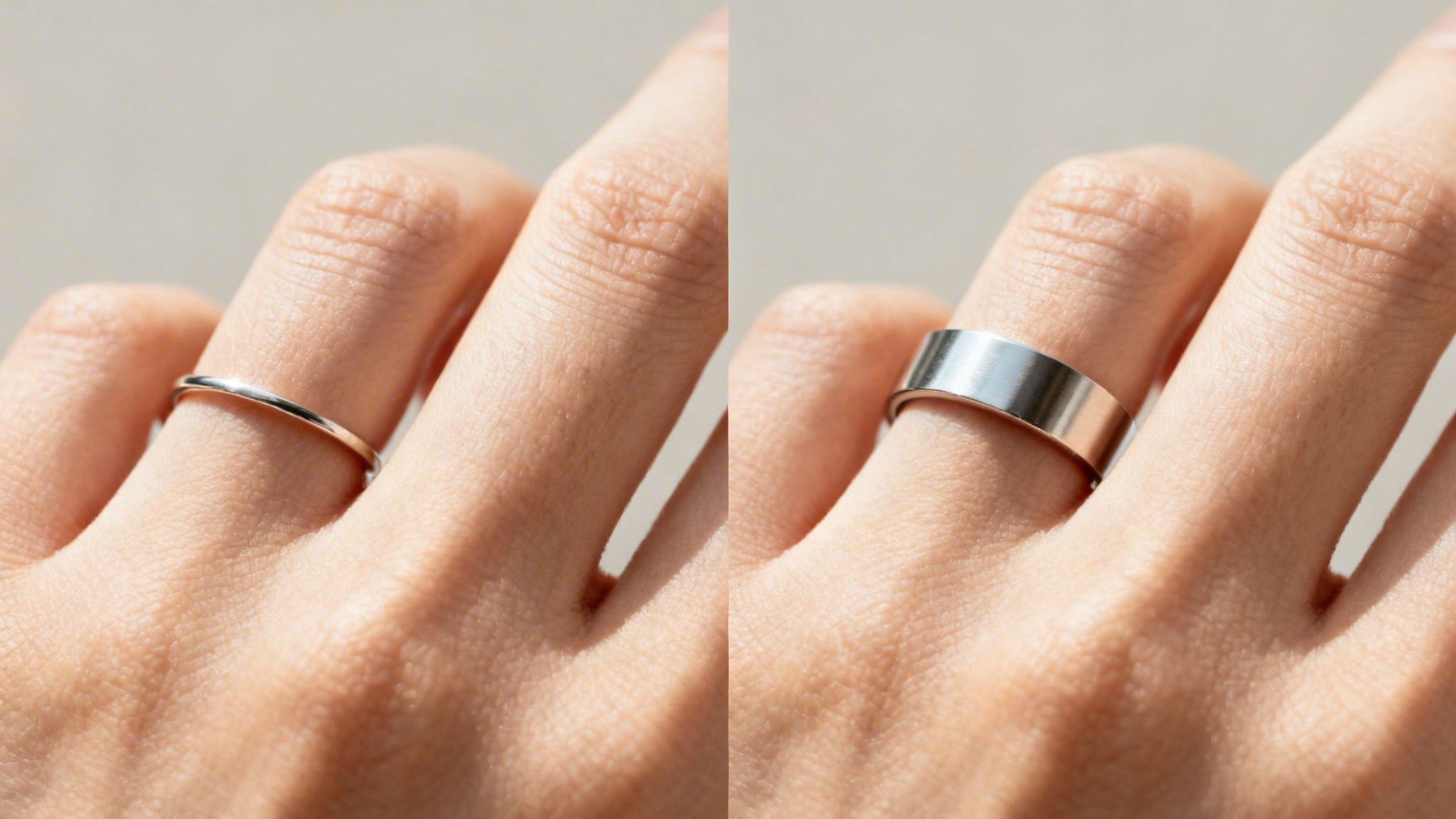
The right fit is more than a number. A few crucial factors can mean the difference between a ring you love and one you never wear.
The width of the band has a significant impact. A wide band creates more friction and feels snugger. For these styles, you often need to go up a quarter or half size from your usual mm ring size.
A delicate, thin band—like many minimalist S925 silver pieces—has less surface contact and fits true to size. If stacking several thin rings, their combined width acts like a single wide band. Account for that.
How a Ring's Shape Changes Everything
A ring's inside profile also affects its feel. There are two main types:
- Standard Fit: A flat interior surface sits flush against your skin for maximum contact.
- Comfort Fit: A slightly rounded interior minimizes metal touching your finger, enhancing comfort, especially with wider rings.
Because a comfort-fit band grips less, it can feel looser than a standard-fit ring of the same size. It’s a small detail that gives a ring a premium, barely-there feel.
Your body is not static. A ring that is perfect in the morning can feel tight by evening. This is normal and something you can plan for.
Your Body's Natural Rhythms
Physiology is the biggest variable. Fingers swell and shrink in response to temperature, humidity, diet, and time of day.
Rings often feel tighter after a salty meal or on a hot day. Fingers also tend to be puffier in the morning. For the most reliable size, measure your finger at the end of the day, at a comfortable room temperature.
This approach helps you find a size that accommodates daily fluctuations. The perfect fit is about all-day comfort. The Ultimate Smart Ring Guide: A 24/7 Comfort Test offers great insights from wear tests.
By keeping these nuances in mind, you're mastering the art of the perfect fit.
Choosing Your Taton Shop Ring With Confidence
You have your exact ring size in millimeters. Now for the fun part.
This precision allows you to browse the Taton.shop collection and focus on what you love, not just what might fit.
S925 Silver vs. 18K Gold Plating
Materials make a difference beyond aesthetics.
Our S925 sterling silver rings are jewelry collection staples. They have a solid, true-to-size feel and are crafted for daily wear.
For a warmer look, consider our pieces with 18K gold plating. They offer a luxuriously smooth finish. The underlying S925 silver ensures the ring's structure and fit remain consistent, so you can choose based on style.
From Measurement To Expression
Knowing your size unlocks creative expression. You can move beyond "will it fit?" and start building a collection that feels like you.
Now you can shop with certainty. Consider how you want to wear your rings:
- Stacking Bands: Layer a few thin S925 silver bands. Because you know your size, the stack will sit just right.
- A Statement Piece: Sometimes, one impactful ring is all you need. Your correct mm size ensures it will feel secure and balanced.
- Mixing Metals: Pair a sterling silver ring with an 18K gold-plated one. The contrast creates a modern, intentional look.
The goal is to bridge the gap between your measurement and your style. When you are confident in the fit, you can focus on the design.
Getting a precise measurement is step one. Modern tools like virtual try-on technology provide another layer of confirmation, letting you see how a piece will look on your hand. Combining data with a solid visual empowers you to buy with certainty.
Common Questions About Ring Sizing
You've measured carefully, but tricky situations can arise. Let's walk through common questions to help you land on the perfect mm ring size.
What If My Measurement Is Between Sizes?
This is common. If your measurement lands between two sizes, choose the larger size. A ring that’s slightly too big is wearable; one that’s too tight is not.
This is especially true for rings with wide bands (over 6mm). The extra surface area creates a snugger feel, so a little more room is essential for comfort.
How Do I Find a Ring Size for a Surprise?
This requires some detective work. The best method is to discreetly borrow a ring they wear on the correct finger. Measure its inner diameter in millimeters. Ensure it's a ring you've seen them wear recently.
If you can't get a ring, ask a close friend or family member if they know the size. If all else fails, the average ring size for women is a US 7 (57mm circumference). It’s a gamble, but it is a solid starting point.
Insider Advice: When buying a gift, consider a style with a simpler band. A plain S925 sterling silver band is easy for any jeweler to resize. Rings with stones or detailed patterns are not.
Does My Knuckle Affect My Ring Size?
Absolutely. The ring must be large enough to slide over your knuckle but not so large that it spins at the base of your finger.
If you have larger knuckles, measure both the knuckle and the base of your finger. Your ideal mm ring size will likely be between those two numbers. You want a fit that goes on with a gentle push and feels secure.
Can S925 Sterling Silver Rings Be Resized?
In most cases, yes. A professional jeweler can resize S925 sterling silver, but it depends on the design.
- Simple Bands: A plain silver band is the easiest to resize, typically up or down a size or two.
- Intricate Designs: A ring with a continuous pattern or channel-set stones is very difficult to resize. Cutting into the band would ruin the design or risk stones falling out.
While resizing is an option, getting the size right from the start is always best. It preserves the ring's original design and integrity.
You now have all the details for a perfect fit. Head over to Taton.shop to explore the collection of S925 silver and 18K gold-plated rings. Shop now and find your next favorite piece with complete confidence.
