
A Guide to Finding Your Perfect Ring Size
An accurate ring size is the foundation of a piece you will wear and love. It is the difference between effortless comfort and a constant distraction. A few millimeters determine the entire experience.
Why a Precise Ring Size Is Essential
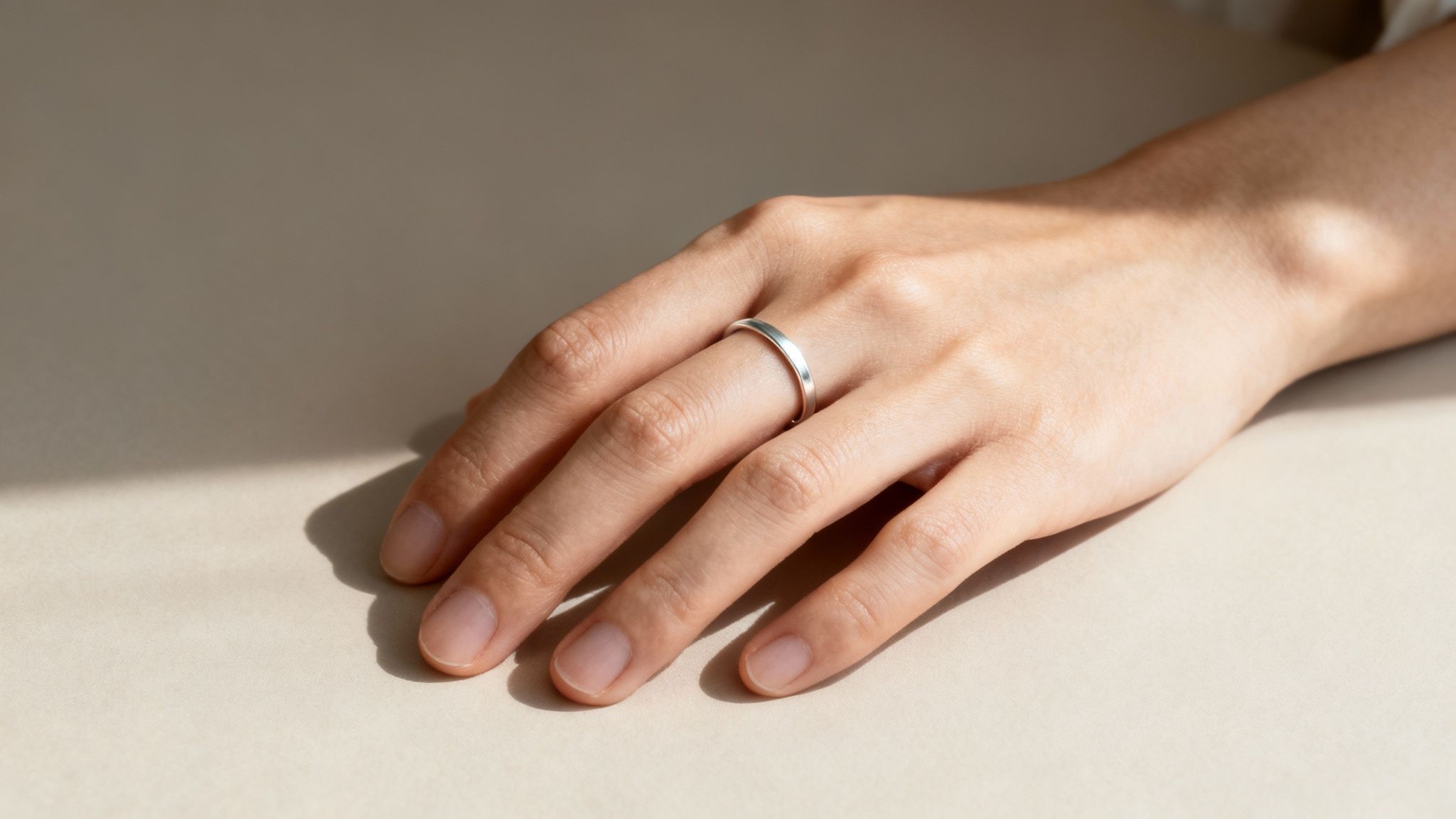
A perfectly fitted ring is a study in balance. It must be snug enough to stay secure, yet loose enough to slide over the knuckle without force. This specific fit ensures both comfort and peace of mind.
When investing in minimalist jewelry, such as the S925 silver rings from Taton.shop, the design is meant to integrate into your life. An ill-fitting ring disrupts this intention.
Guesswork often leads to a poor result. A ring that is too tight is uncomfortable and can restrict circulation. A ring that is too loose is easily lost.
How Precision Defines Your Purchase
Determining your correct size from the start saves the time and expense of resizing. This process is not possible for all designs, particularly those with intricate settings. It also provides the confidence to purchase online, knowing the piece will be ready to wear.
This need for accuracy is critical as the jewelry market expands. The global rings market is forecast to grow by USD 45.2 billion between 2023 and 2028. You can read the full research on the rings market to understand industry trends.
A correctly sized ring should feel like an extension of you. Its presence is felt only when a subtle glint catches your eye. This is the mark of a perfect fit.
This guide removes the guesswork. We will outline simple, effective methods to find your size, ensuring your next piece is both comfortable and well-suited to you.
How to Measure Your Ring Size at Home
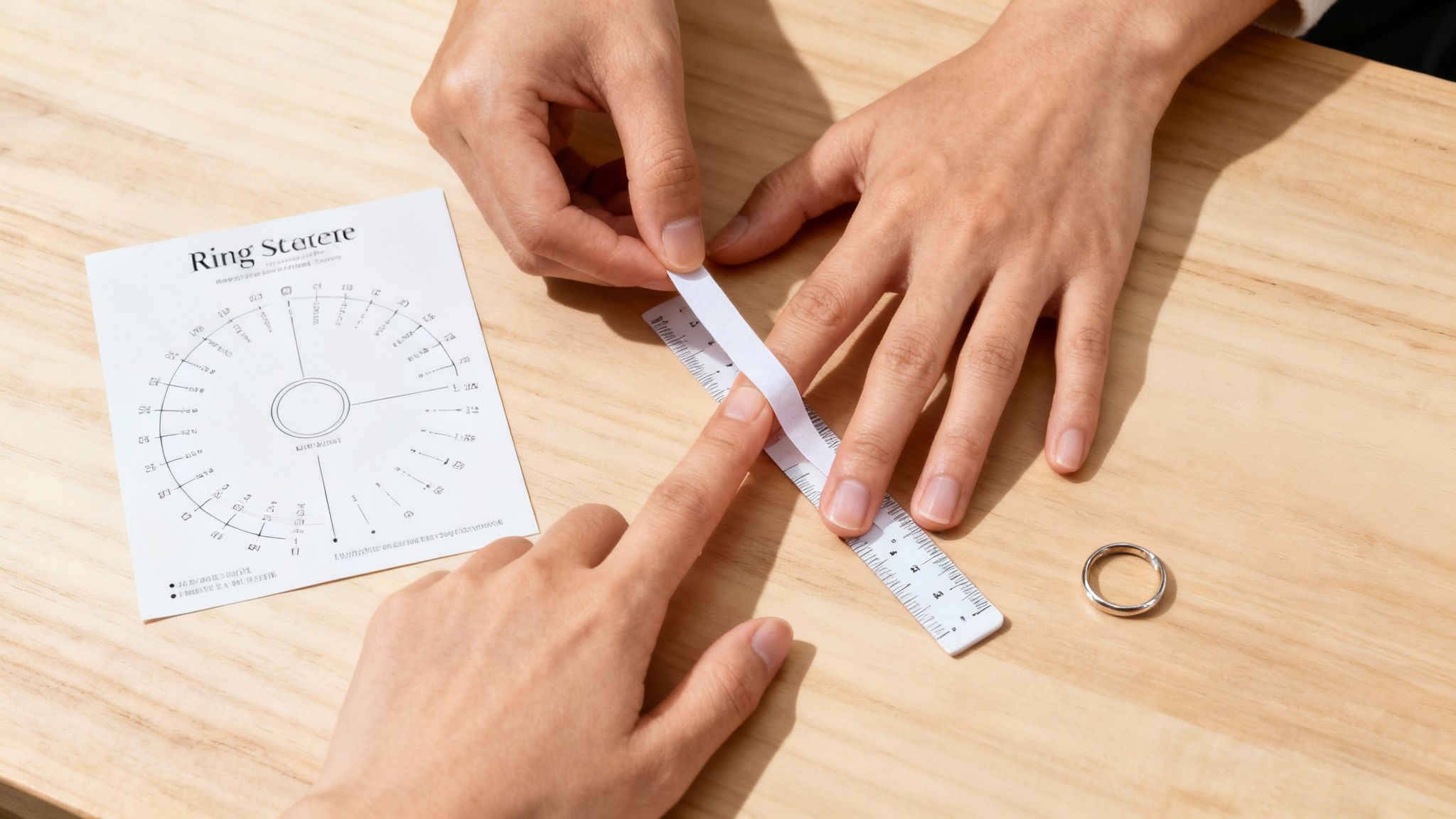
You do not need to visit a jeweler to determine your ring size. With common household items and careful attention, you can achieve an accurate measurement at home.
These techniques are simple and effective. The key, as with most things, is in the details. Precision is what makes the difference.
The Existing Ring Method
This is the most reliable method for at-home sizing. Use a ring you already own that fits the intended finger.
Choose a ring with a band width similar to the one you plan to purchase. A wide band will feel tighter than a thin one of the same size.
Using a ruler with millimeter markings, measure the internal diameter of the ring. Place the ruler across the center, measuring from one inside edge to the other. Measure only the open space, not the metal itself.
Precision is critical. A half-millimeter can equate to a full ring size. Measure carefully, then measure again. Use a standard ring size chart to convert your diameter measurement.
The Paper or String Method
If you do not have a ring that fits, a thin strip of paper or non-stretchy string is the next best option. This method measures the circumference of your finger directly.
Cut a strip of paper approximately 10 cm long and 5 mm wide. Wrap it snugly around the base of your finger. The fit should be firm but not tight, with enough room to slide over your knuckle.
Mark the point where the paper overlaps with a pen. Unwrap the paper, lay it flat, and measure the distance from the end to your mark in millimeters. This number is your finger's circumference.
Common Mistakes to Avoid:
- Using Stretchy String: Materials like yarn or elastic will stretch and provide an inaccurate, smaller measurement.
- Wrapping Too Tightly: This is a common error that results in ordering a ring that is too small or uncomfortable.
- Forgetting the Knuckle: If your knuckles are larger than the base of your finger, measure both areas. You will need a size that can pass over the knuckle without being too loose at the base.
Using a Printable Ring Sizer
A printable ring sizer is another useful tool. Many jewelers, including Taton.shop, offer a downloadable PDF. It is essential to print the document at 100% scale to ensure accuracy.
These guides typically offer two measurement options:
- The Cut-Out Sizer: A paper ruler that you cut out and wrap around your finger like a belt to find your size.
- The Circle Chart: A series of circles corresponding to ring sizes. Place an existing ring on the circles to find a perfect match with the inside edge.
Before using the sizer, always check the printed scale guide with a ruler to confirm it printed correctly.
Understanding International Ring Size Charts
Shopping for rings online can be confusing due to varying international sizing systems. A US size 7 is not the same as a UK size 7 or a European 7.
This discrepancy is a primary reason for online returns. For example, a US size 7 is equivalent to a UK size N or a European size 54. Understanding these conversions is key to a successful purchase.
Decoding Different Sizing Systems
Most online retailers use one of three main sizing systems. The logic behind each is straightforward.
- US & Canada: A numerical scale, often including half and quarter sizes for precision.
- UK & Australia: An alphabetical system, also commonly using half sizes (e.g., O½).
- Europe (ISO 8653): The most direct standard. The size is the inner circumference of the ring in millimeters. A size 54 ring has a 54 mm circumference.
An estimated 70% of first-time online ring buyers select the wrong size, not just from inaccurate measurement, but from misinterpreting sizing systems.
A ring size chart is a translator. It connects your measurement to the jeweler's standard, ensuring the ring you receive fits as intended.
Millimeters: The Universal Measurement
Regardless of the sizing system, the physical measurement in millimeters (mm) is the one constant. This is the foundation of all sizing and your most reliable piece of information.
As the global rings market grows by a projected USD 35.86 billion between 2024 and 2028, shoppers are buying from jewelers worldwide. You can explore fascinating market trends to see the industry's global scale. Relying on a universal unit like millimeters enables confident international shopping.
International Ring Size Conversion Chart
This conversion chart provides clarity. Use your known size or millimeter measurement to find its equivalent across major international systems.
| Circumference (mm) | US & Canada Size | UK & Australia Size | Europe (ISO) Size |
|---|---|---|---|
| 49.3 mm | 5 | J½ | 49 |
| 51.9 mm | 6 | M | 52 |
| 54.4 mm | 7 | O | 54 |
| 57.0 mm | 8 | Q | 57 |
| 59.5 mm | 9 | S | 60 |
| 62.1 mm | 10 | T½ | 62 |
| 64.6 mm | 11 | V½ | 65 |
| 67.2 mm | 12 | Y | 67 |
Using this chart removes guesswork. If your finger's circumference is 57 mm, you require a US size 8, a UK size Q, or a European size 57. All refer to the same fit.
This is the final check that ensures a successful purchase.
Expert Tips for a Perfect Ring Fit
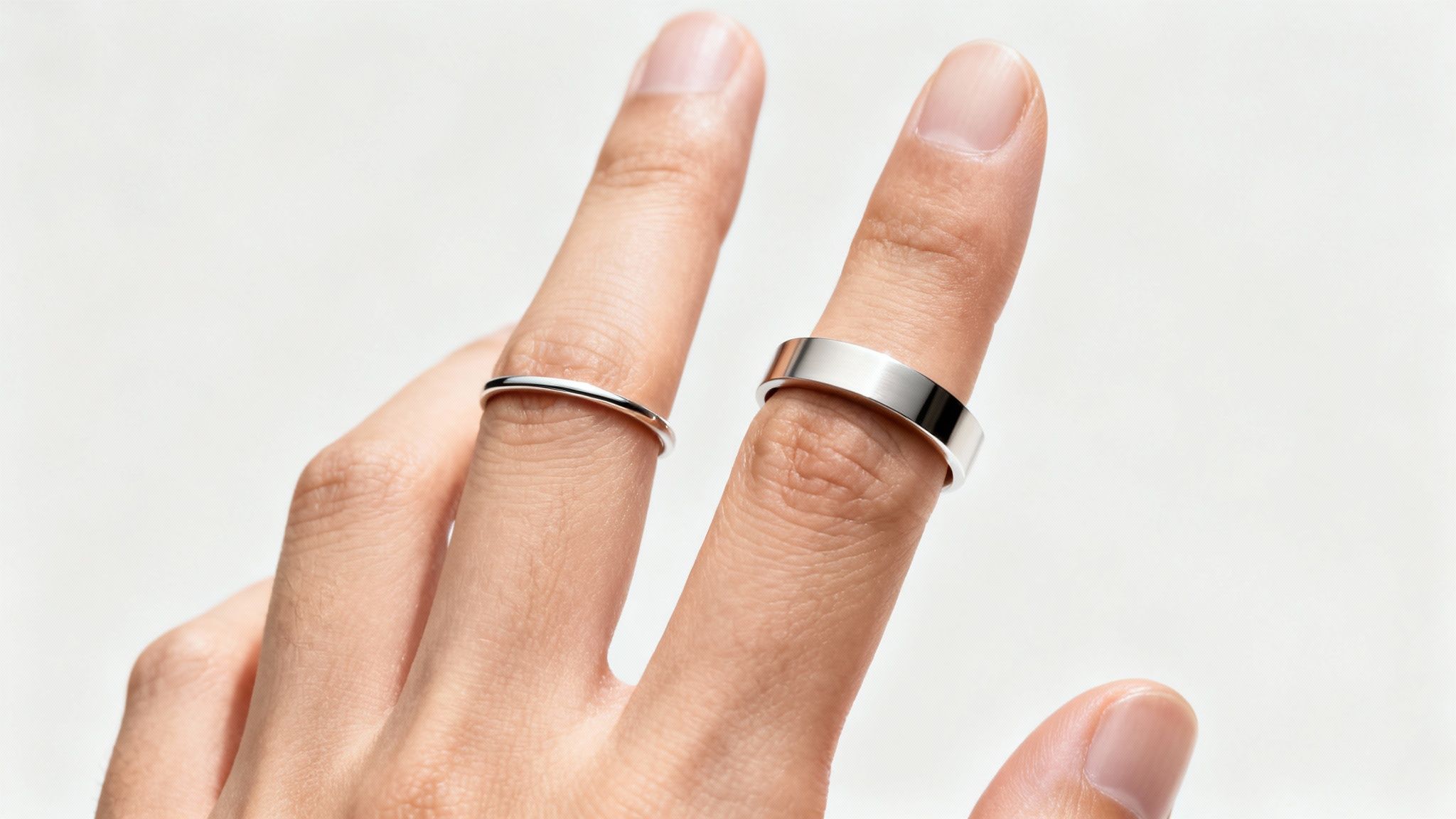
An accurate measurement is the starting point, but other factors influence how a ring feels. Understanding these nuances moves a fit from "correct" to truly comfortable.
These are the details professional jewelers consider. They provide confidence in your selection, ensuring the ring feels made for you.
Consider the Impact of Band Width
A ring's band width significantly affects its fit. A wider band covers more skin, creating more friction and making it feel much tighter than a slim band of the same size.
A delicate 2mm band will likely feel true to size. For a bolder piece, such as a 6mm or 8mm band, we recommend going up a half-size. This small adjustment provides necessary room and prevents a restrictive feeling.
A wider band occupies more space on your finger. Sizing up slightly compensates for this, allowing for natural finger fluctuations throughout the day.
Time and Temperature Matter
Your fingers are not a static size. They shrink and swell in response to temperature and activity. Fingers are often smaller in the morning or in cold conditions, and larger in the evening or in warm weather.
For the most reliable result, measure your finger at the end of the day at a comfortable room temperature. Measuring when your hands are cold may result in buying a ring that becomes too tight. Measure a few times over several days to find a consistent average.
Navigating Knuckles and Stacks
If your knuckle is larger than the base of your finger, you need a size that can slide over it but will not spin once in place.
Aim for a size that requires a gentle twist to get over the knuckle. This indicates a secure and comfortable fit.
The same logic applies to stacking rings. Each additional ring increases the total width, making the stack feel tighter.
- For a stack of three or more thin rings: Consider going up a half-size.
- For mixing wide and thin bands: Base your size on the widest ring in the set, which usually means sizing up.
How to Discreetly Find Someone's Ring Size

Gifting a ring is a significant gesture. Determining the recipient's size without revealing the surprise is an art that requires stealth and planning. Getting it right makes the moment perfect.
The goal is to gather information without raising suspicion. The right approach allows you to choose a ring that fits flawlessly.
The Borrow-and-Measure Tactic
This is the most accurate method. Discreetly borrowing one of their rings at an opportune time—while they are sleeping or in the shower—is highly effective.
Two details are crucial for this mission:
- Check the Finger: You must know which finger and hand the borrowed ring is worn on. The dominant hand is often slightly larger.
- Observe the Fit: Note how the ring fits them. Is it loose or snug? This context helps refine the size selection.
Once you have the ring, a jeweler can provide a professional measurement. Alternatively, you can measure the internal diameter yourself with a ruler. Return the ring promptly to its original place.
A borrowed ring is the best source of intelligence. It provides a direct physical measurement, removing nearly all guesswork and ensuring a perfect fit.
The Paper Tracing Method
If borrowing the ring is too risky, tracing it is an excellent alternative. When they remove the ring, place it flat on a piece of paper and carefully trace the inside circle with a sharp pencil.
This creates a record of the internal diameter. Tracing it several times can provide a reliable average. A jeweler can use these tracings to determine the correct size. It is a low-risk, high-success strategy.
Enlist Help from Friends and Family
A trusted friend or family member can often obtain information more naturally. They can suggest a casual shopping trip that includes a jewelry store or bring up ring sizes in conversation.
This approach is particularly useful if the person does not wear rings. A friend can ask questions that might seem suspicious coming from you, maintaining the element of surprise. Choose an ally who can keep a secret.
Answering Your Top Ring Sizing Questions
Even with the best methods, questions can arise. Below are answers to the most common queries, providing a final checklist for achieving the perfect fit.
I’m Between Two Sizes—What Now?
If your measurement falls between two sizes, choose the larger one.
It is much simpler for a jeweler to make a ring slightly smaller than to make it larger. The extra room also accommodates the natural swelling of your fingers in warm weather or at the end of the day. For rings with wider bands (over 6mm), sizing up a half-size is a smart choice for comfort.
Are My Fingers a Different Size on Each Hand?
Yes. The fingers on your dominant hand are typically about a half-size larger than on your non-dominant hand. This is due to increased use, which results in slightly larger muscles and knuckles.
Always measure the specific finger on the specific hand where the ring will be worn. Measuring your left ring finger will not yield an accurate size for your right.
Can Any Ring Be Resized?
No, not all rings can be resized. Getting the size right the first time is crucial for certain styles. Most rings made of precious metals like S925 silver, gold, or platinum can be adjusted by a skilled jeweler.
However, some designs cannot be altered:
- Eternity Bands: With gemstones set around the entire band, there is no plain metal to work with.
- Hard Metals: Materials like tungsten, titanium, and ceramic are too durable to be resized with standard tools.
- Intricate Patterns: Resizing a ring with a continuous engraving or pattern will damage the design.
How Should a Ring Actually Fit?
A perfect fit is a balance of security and comfort.
The ring should be snug enough that it will not fall off during daily activities. It must also be loose enough to slide over your knuckle without a struggle. You will be aware of the ring, but it should not pinch or restrict circulation. A simple test: put the ring on and shake your hand gently. If it stays in place, the fit is likely correct.
At Taton.shop, we believe minimalist design and a perfect fit are inseparable. Explore our collection of S925 silver rings, crafted for comfort and timeless style, at https://taton.shop.
