
How to Determine Ring Size for a Perfect Fit
Finding your ring size is precise. It involves measuring your finger's circumference in millimeters and matching it to a standard size. The most reliable methods use a paper strip or an existing ring. Factors like temperature or band width can affect the fit, so accuracy is key.
Understanding Ring Sizing Fundamentals
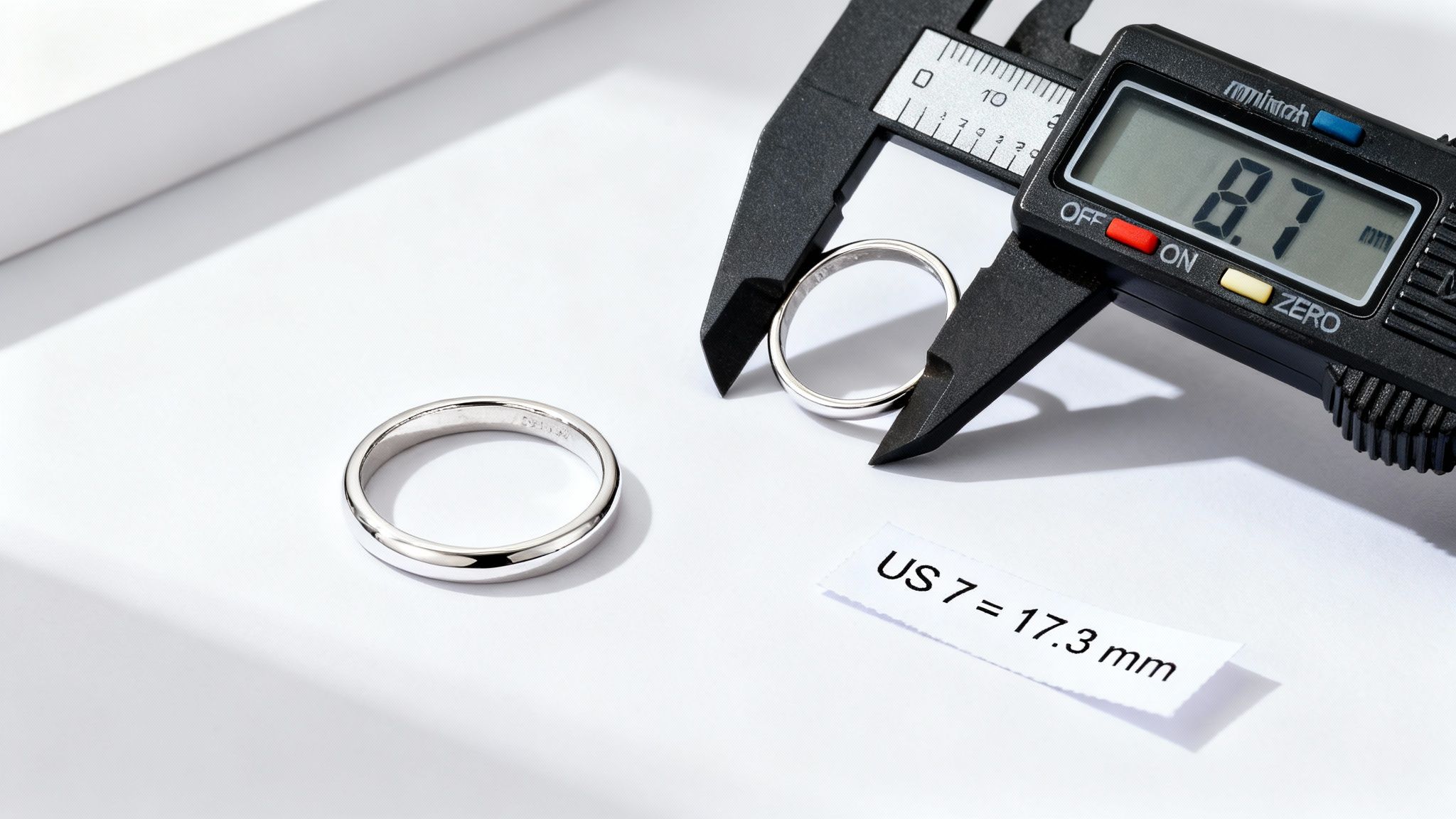
A ring size is the specific inner circumference of the band. Understanding this turns a guess into a precise calculation, ensuring your chosen piece from Taton.shop fits perfectly.
For instance, a US "size 7" corresponds to a finger circumference of 54.4 millimeters. The difference between half-sizes is only about 0.4 millimeters, making precision essential. A small miscalculation can result in a ring that is either too tight or uncomfortably loose.
Why Sizing Systems Differ Globally
The US and Canadian numerical system is just one of many. International standards vary, which can complicate online shopping if you are unprepared.
Common sizing systems include:
- United Kingdom & Australia: An alphabetical system (L, M, N).
- Europe & Germany: The direct inner circumference in millimeters. A size 54 means a 54 mm circumference.
- Japan & Asia: A unique numerical system that does not align with US sizes.
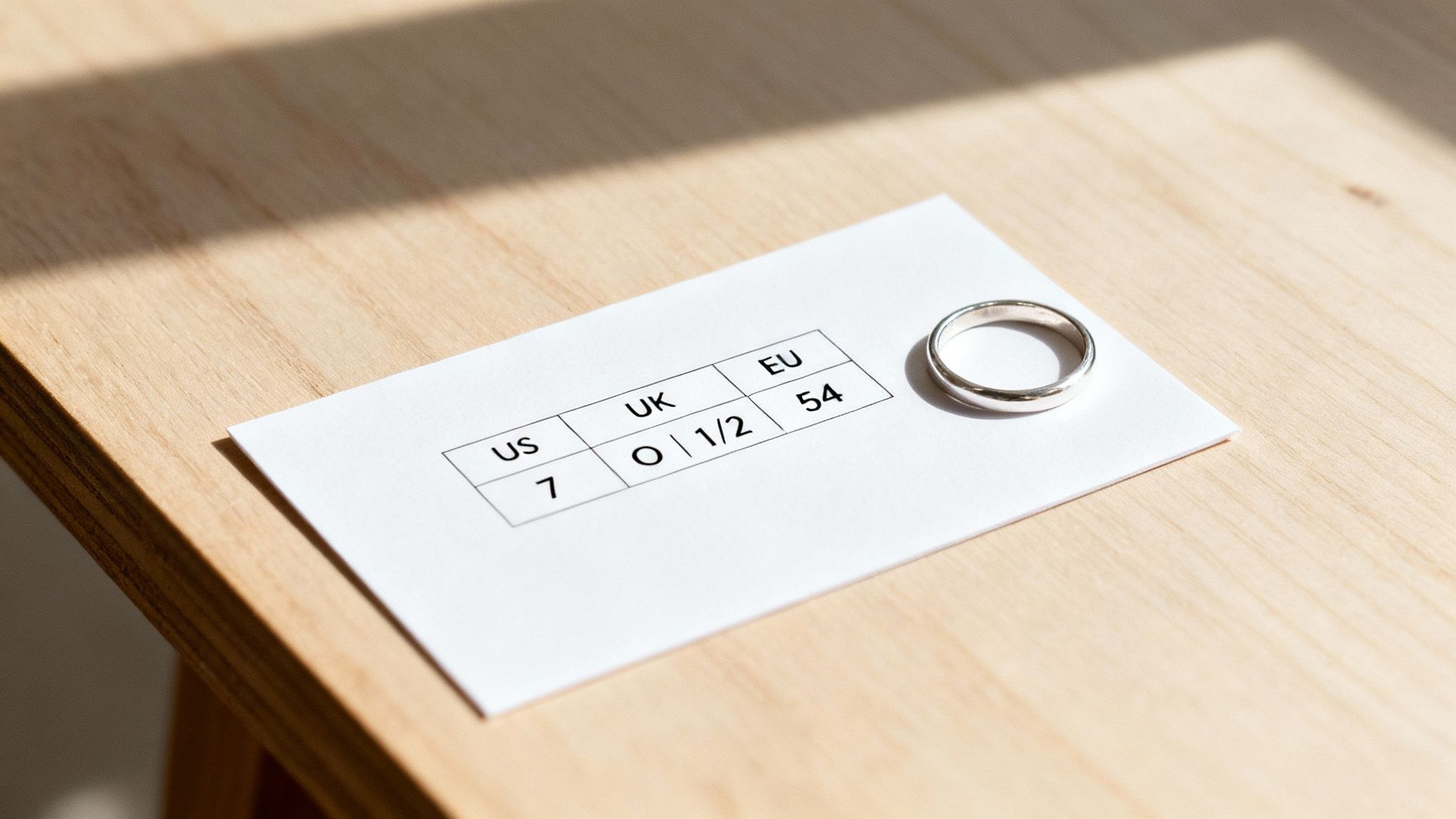
Knowing these differences is crucial for an informed purchase. It allows you to confidently order a German size 54, knowing it equates to a US size 7.
Establishing a Realistic Benchmark
It is helpful to know average ring sizes as a reference point. An analysis by My Irish Jeweler found that 50% of women's ring sizes are between 6 and 8, with size 7 being the most common. For men, the typical range is 9 to 11, with size 10 being the most frequent.
These averages vary globally. You can explore more data on average ring sizes and influencing factors at My Irish Jeweler.
Pro Tip: Your dominant hand is often up to a half-size larger. Always measure the exact finger on which you will wear the ring for the most accurate fit.
This foundational knowledge ensures success. The premium materials in our jewelry, such as sterling silver, deserve a perfect fit. Learn more about what makes S925 silver special. By understanding these basics, you are ready to measure with precision.
Two Reliable Methods for At-Home Sizing
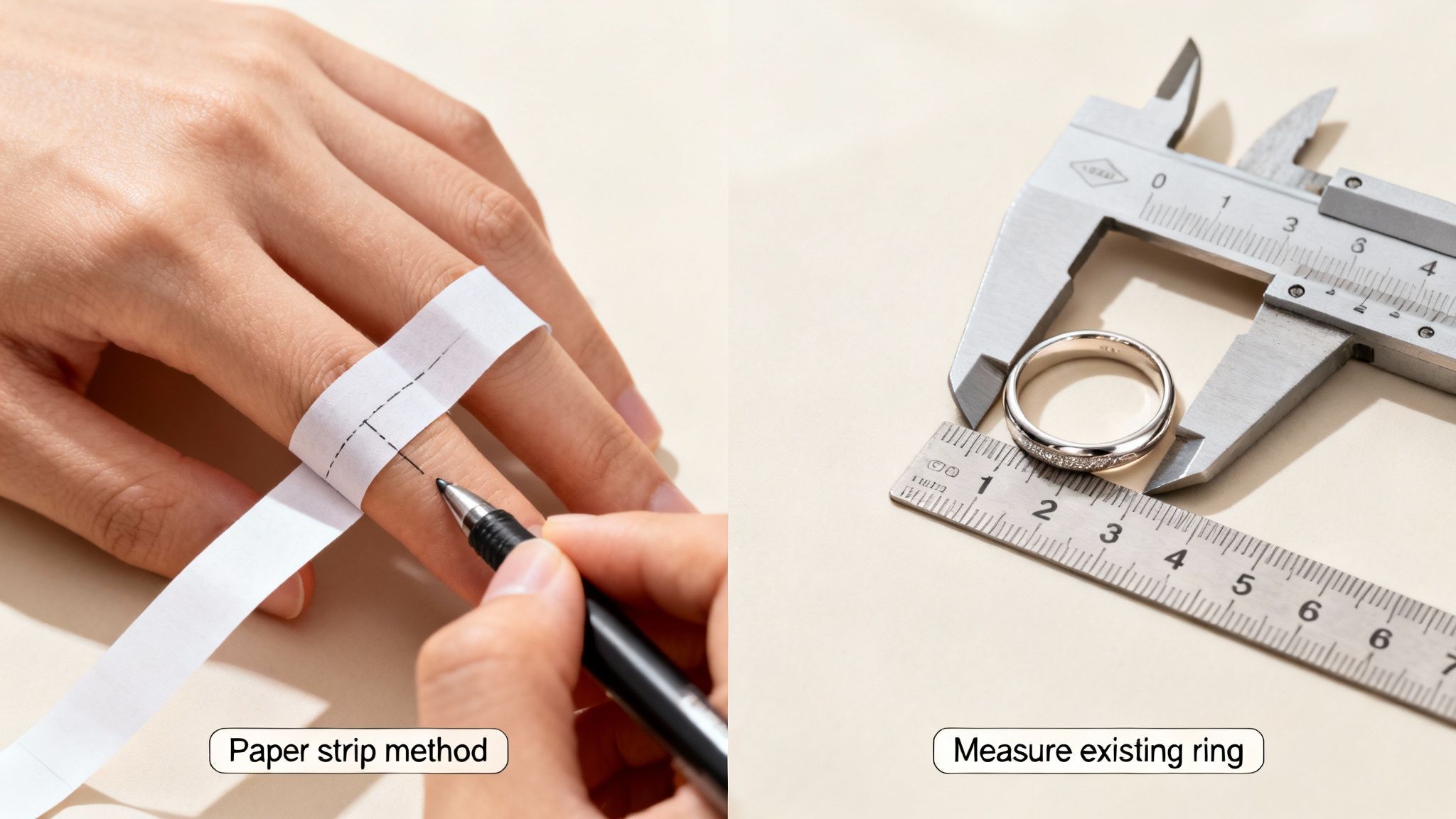
You can achieve an accurate measurement at home without visiting a jeweler. The key is meticulousness, as even a minor error can alter the final fit. We will cover the two most dependable DIY techniques: the paper strip method and measuring an existing ring.
The Paper Strip Method: Measuring Your Finger's Circumference
This classic approach directly measures your finger's circumference and is ideal if you do not have a ring that fits. Precision is paramount, as a single millimeter can shift the size.
Here is the correct process:
- Cut a thin, straight strip from non-stretch paper, such as printer paper.
- Wrap the strip snugly around the base of your finger. It should be firm but not constricting.
- Gently slide the paper loop over your knuckle. It must be loose enough to pass without tearing. Adjust if it gets stuck.
- Mark the exact point where the paper overlaps with a fine-point pen.
- Lay the strip flat and measure the length from the end to your mark in millimeters (mm). This is your finger's circumference.
A common error is pulling the paper too tight. The strip should feel like a well-fitting ring: secure, yet able to slide over the knuckle comfortably.
The Existing Ring Method: Measuring the Diameter
If you have a ring that fits the intended finger perfectly, this method is faster and often more reliable. It eliminates the guesswork of clearing your knuckle.
First, ensure the ring you measure has a band width similar to the style you plan to buy. A wide band feels tighter than a thin one, so comparing similar styles is essential for an accurate fit.
Follow these steps:
- Place your ring on a flat surface.
- Use a ruler with millimeter markings to measure the internal diameter. This is the distance from one inside edge straight across to the other, excluding the metal of the band.
- Convert this internal diameter measurement to a standard US ring size. For more detailed instructions, see our guide on how to measure your finger for a ring.
Modern tools offer alternatives. Printable ring sizers are used by about 60% of online shoppers, while 40% of millennials use smartphone apps for virtual try-ons, increasing purchase confidence.
Navigating International Ring Size Differences
Ring sizing is not universal. A familiar size in one country may mean something entirely different elsewhere, turning a confident purchase into a gamble. Understanding these regional systems is the key to accuracy.
The most common system is the US/Canada standard, which uses a numerical scale where each half-size corresponds to a precise change in circumference. However, with over 25 distinct sizing systems worldwide, direct translation is often inaccurate.
Getting to Know the Main Sizing Systems
To shop with confidence, it helps to understand the logic behind the major international standards. Each aims for a comfortable fit but uses a different method.
The three primary systems are:
- US/Canada Standard: A numerical scale (e.g., Size 5, 6, 7).
- UK/Australia Standard: An alphabetical system (e.g., Size J, K, L).
- European (ISO 8653) Standard: The most direct method, where the size equals the ring's inner circumference in millimeters. A size 54 means a 54 mm circumference.
This is why a German size 54 corresponds to a US size 7. They are different notations for the same measurement.
Converting Your Size with Confidence
For a global brand like Taton.shop, translating between systems is crucial. A reliable conversion chart eliminates guesswork. The following table shows how different measurements align.
International Ring Size Conversion Chart
| Circumference (mm) | Diameter (mm) | US/Canada Size | UK/Australia Size |
|---|---|---|---|
| 49.3 mm | 15.7 mm | 5 | J 1/2 |
| 50.6 mm | 16.1 mm | 5.5 | L |
| 51.9 mm | 16.5 mm | 6 | M |
| 53.1 mm | 16.9 mm | 6.5 | N |
| 54.4 mm | 17.3 mm | 7 | O |
| 55.7 mm | 17.7 mm | 7.5 | P |
| 57.0 mm | 18.1 mm | 8 | Q |
| 58.2 mm | 18.5 mm | 8.5 | R |
| 59.5 mm | 19.0 mm | 9 | S |
| 60.8 mm | 19.4 mm | 9.5 | T |
For example, a UK size 'M' corresponds to a 51.9 mm circumference, which is a US size 6. This knowledge allows you to shop from anywhere with certainty.
A reliable conversion tool is essential. It lets you focus on the design of the ring, not the logistics of the fit.
Our comprehensive Taton.shop ring size chart simplifies this process. It provides clear conversions between US, UK, and European standards, ensuring you find a perfect match in our collection.
Key Factors That Influence Your Ring Fit
A single measurement is not enough. Our fingers change size subtly throughout the day in response to temperature, activity, and diet. A perfect fit accommodates these natural fluctuations. Understanding these variables is the secret to finding a size that remains comfortable.
The Impact of Temperature and Time of Day
Your fingers shrink in the cold and swell in the heat, sometimes by as much as half a size. This makes the timing of your measurement critical.
- Best Time to Measure: Late afternoon or early evening. Your fingers are at their most stable, average size for the day.
- Worst Time to Measure: In the morning (due to fluid retention) or when your hands are cold (which can result in a measurement that is too small).
The goal is to measure your finger at its "new normal"—the state it is in for most of the day. This provides the most reliable data for an all-day comfortable fit.
How Ring Design Affects the Fit
The ring's design is as important as the measurement. A size 7 in a thin band will not fit the same as a size 7 in a wide band. A wider ring covers more skin, creating more friction and a much snugger feel.
Follow this simple rule:
- For Wide Bands (6mm or more): Size up by at least a half-size. The extra width displaces more of your finger, making the ring feel tighter.
- For Thin Bands (under 3mm): Your standard size will likely fit well, as there is less material in contact with your finger.
If you measure as a size 7 for a thin band, you should select a size 7.5 for a substantial statement piece. This is a crucial detail for designs like our S925 Sterling Silver Crossover Ring. Accounting for both your body's daily rhythms and the ring's design ensures a perfect fit.
Common Sizing Mistakes and How to Avoid Them
While sizing at home seems simple, common mistakes can lead to inaccurate results. With measurements in millimeters, even a small error can result in a poor fit. Knowing the potential pitfalls helps you get it right the first time, especially when ordering from Taton.shop.
Choosing the Wrong Measuring Tool
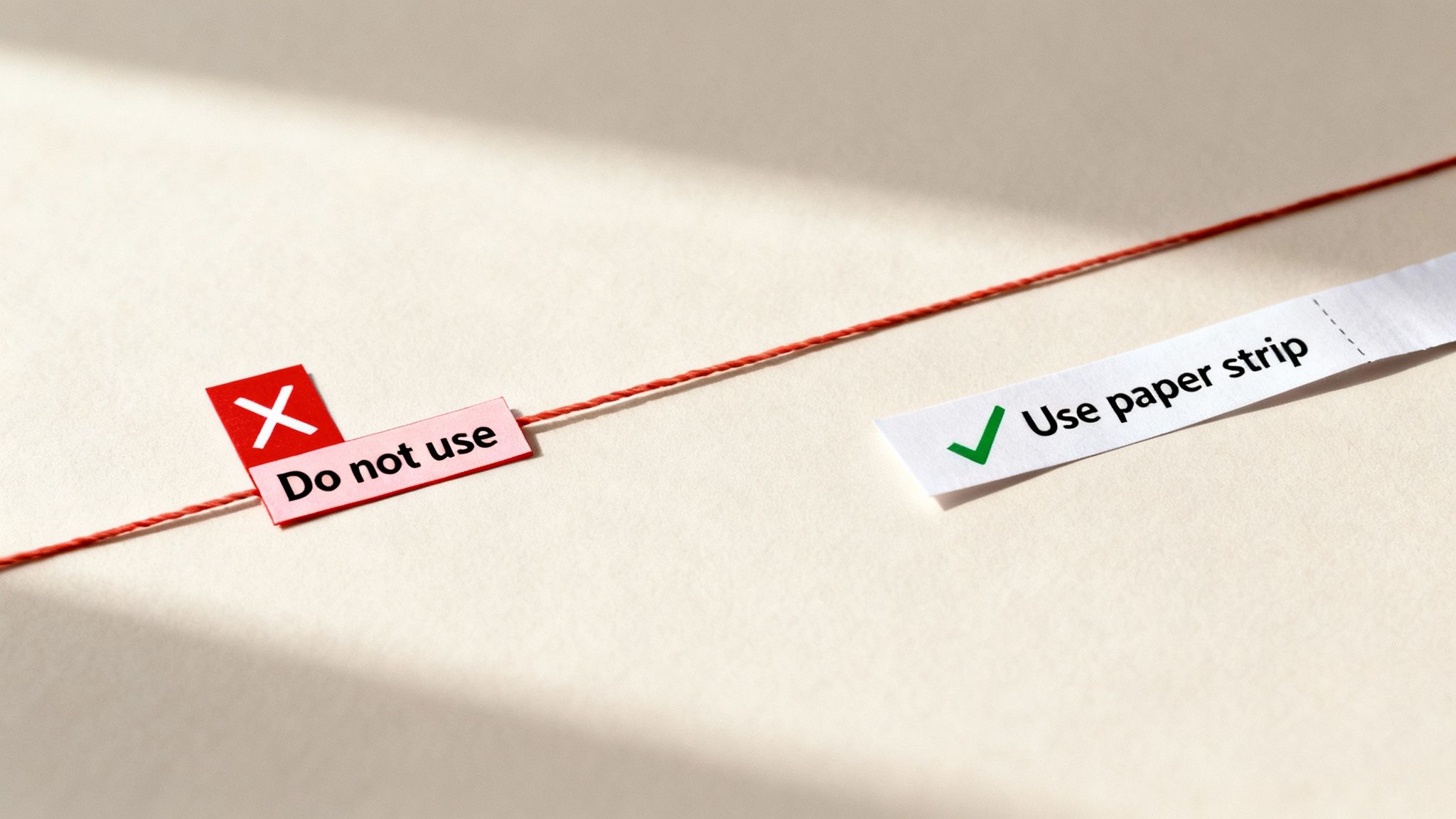
This is the most frequent error. Many guides suggest using string or floss, but these materials stretch and compress the finger, leading to a measurement that is too small.
Instead, use a tool that holds its shape:
- A paper strip: Cut a thin, straight strip from standard printer paper. It is firm and does not stretch.
- A flexible tailor's tape: A soft sewing tape is designed for accurate circumference measurements.
Using a non-stretch material like a paper strip eliminates the largest source of error.
A flawed tool guarantees a flawed measurement. Start with the right material for an accurate at-home sizing.
Ignoring Your Knuckle
Another common mistake is measuring only the base of the finger. The ring must be able to slide comfortably over your knuckle. Before marking your paper strip, test that the loop can pass over the knuckle without a struggle.
For those with larger knuckles, you may need to go up a half-size to accommodate them. It is a small but critical adjustment. For a deeper dive, our guide to measuring your finger for a ring offers more tips.
Finally, remember timing and temperature. For the most reliable reading, measure in the late afternoon at room temperature when your finger is at its most stable size. Avoiding these common pitfalls transforms a guess into a precise measurement.
Common Questions About Finding Your Ring Size
You have measured and double-checked, but a few questions often remain. Resolving these final details is the difference between a ring that fits and one that feels custom-made. Here are answers to common scenarios to help you choose your piece from Taton.shop with confidence.
What if I'm Between Two Ring Sizes?
When your measurement falls between two sizes, always choose the larger size. A ring that is slightly too loose is easily adjusted with an inexpensive ring guard. A ring that is too tight is unwearable and may require costly resizing, if the design permits. This is especially true for wider bands.
How Can I Find Someone's Ring Size for a Surprise?
This requires some subtlety. The most reliable method is to borrow a ring they wear on the exact same finger. Measure its inside diameter and use a sizing chart. Ensure the borrowed ring has a similar band width to the one you plan to buy. If that is not possible, ask a close friend or family member to assist.
As a last resort, you can reference average ring sizes, but this is a gamble. Ensure the return policy is flexible when gifting jewelry.
Is My Dominant Hand a Different Size?
Yes. The fingers on your dominant hand are typically about a half-size larger than those on your non-dominant hand due to more frequent use. Always measure the specific finger on the specific hand where the ring will be worn. Never assume your right and left ring fingers are identical.
How Reliable Are Printable Online Ring Sizers?
A printable sizer can be accurate if you follow the printing instructions precisely. The critical step is to print the page at 100% scale. Disable any "fit to page" options, as they will distort the measurement. Always verify the printed scale with a physical ruler before measuring. If they do not match, the sizer is inaccurate.
With these answers, you are prepared to select your ring with confidence. Explore the curated collection of S925 silver and 18K gold-plated rings at Taton.shop. Find your new favorite ring today.