
How to clean silver: professional tips and home methods
Silver jewelry loses its original shine over time, becoming covered with a dark coating. This is a natural chemical process, and not a sign of poor quality of the product. It's all about the reaction of silver with sulfur compounds that are in the air, cosmetics and even on our skin.
Why does silver darken?
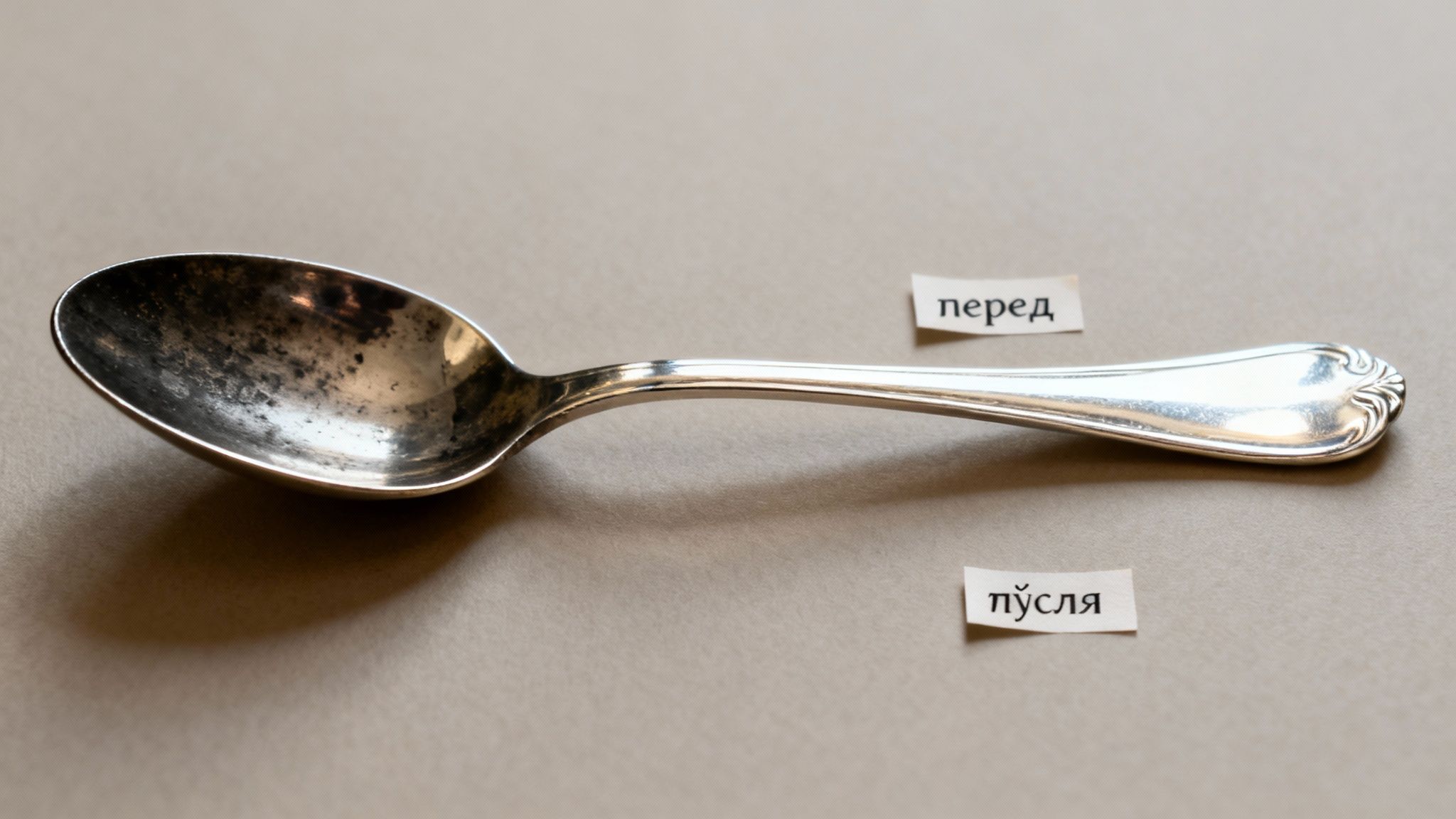
Silver tarnishing is a result of sulfidation. When silver comes into contact with sulfur compounds, a thin film of silver sulfide ( Ag₂S ) forms on the surface of the metal, giving it a dark hue. This process does not destroy the metal, but only creates a surface coating.
The rate at which silver tarnishes depends on many factors, from climate to individual body characteristics. Understanding these causes is the first step to proper care and how to clean silver effectively and safely.
The main causes of darkening
The behavior of silver can vary from person to person and in different conditions. This is due to both external factors and our body chemistry.
The main catalysts that accelerate the appearance of plaque:
- Air and humidity. Hydrogen sulfide ( H₂S ) in the air is the main culprit. High humidity speeds up the reaction, so jewelry will tarnish more quickly in a bathroom or coastal climate.
- Cosmetics and perfumes. Creams, lotions, and perfumes contain chemicals that can react with silver. The rule is simple: put on jewelry last.
- Household chemicals. Aggressive products, especially those containing chlorine, can cause instant darkening and even damage the metal surface.
- Contact with food. Foods rich in sulfur—onions, egg yolks, mayonnaise—can leave marks on jewelry during cooking.
- Individual differences. The composition of sweat is unique. Changes in hormonal levels, stress, or diet can affect the amount of sulfur excreted through the skin.
Tarnishing is a fate for even the highest quality sterling silver. 925 sterling silver, which contains 7.5% copper for strength, is more susceptible to this process than pure metal. Read about the properties of this alloy in our article about 925 sterling silver jewelry .
Fortunately, this process is completely reversible. There are a variety of methods—from tried-and-true home remedies to professional tools—that make it easy to restore the shine to your jewelry.
Home methods for cleaning silver that really work
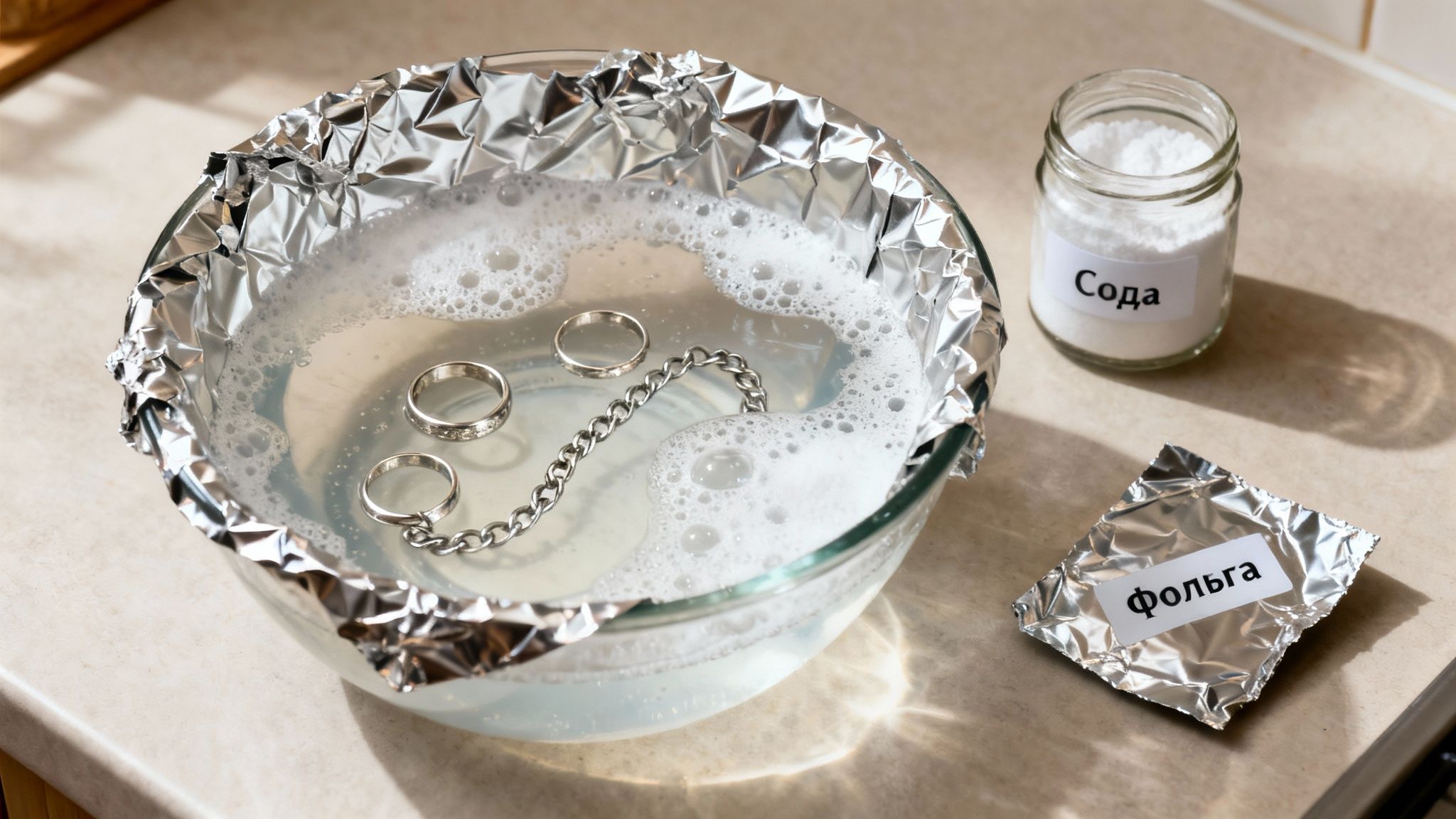
You can restore the shine to silver without a visit to a jeweler. Every kitchen has products that can effectively deal with tarnish. The choice of method depends on the degree of darkening and the presence of delicate inserts.
One of the most effective and gentle methods is a combination of baking soda and aluminum foil. The method works through a chemical reaction rather than mechanical friction, which eliminates the risk of micro-scratches.
Baking soda and foil: chemistry in your kitchen
This method is ideal for heavily tarnished items without stones: chains, bracelets, or silverware.
What you will need:
- Glass or ceramic container.
- A sheet of aluminum foil.
- Hot water.
- Baking soda.
Line the bottom of the container with foil, shiny side up. Arrange the decorations on the foil, ensuring each item is in contact with it.
Prepare a solution: 2 tablespoons (about 50 g) of baking soda per 1 liter of hot water . Pour over the jewelry. A slight hissing and a specific smell of hydrogen sulfide are signs that the reaction has begun.
Scientifically speaking, this is an electrochemical reaction. The soda solution acts as an electrolyte, and silver and aluminum form a galvanic pair. Aluminum, as a more active metal, “draws” sulfur atoms from the dark coating onto itself, returning the silver to its pure appearance.
Leave the jewelry in the solution for 10-30 minutes , depending on the degree of darkening. Then carefully remove the jewelry, rinse thoroughly under running water, and wipe dry with a soft, lint-free cloth.
This method is a modern interpretation of the old method of boiling silver with soda. However, the intense boiling is too aggressive for modern jewelry, especially with pearls or opals.
Gentle alternatives for light soiling
For jewelry that has only slightly lost its shine or items with delicate inlays, you should choose more gentle methods. These principles are similar to caring for other precious metals. You can read our guide on how to clean gold at home .
Warm soapy water
This is the safest option for regular care, ideal for jewelry with stones, enamel, or gold plating.
- Dissolve a drop of mild soap in warm water.
- Soak the jewelry in the solution for 5–10 minutes .
- Use a very soft toothbrush to carefully go over all the curves.
- Rinse under clean water and dry.
This method effectively removes grease, makeup residue, and dust.
Toothpaste: Popular but risky
Jewelers are skeptical of this folk method because of the abrasiveness of toothpaste. The microparticles in its composition can leave a network of scratches on soft silver.
If you decide to use this method:
- Use only regular white toothpaste , without whitening crystals.
- Apply the paste to a soft cloth, not to the product.
- Clean in light, circular motions without pressure.
- Thoroughly rinse off any remaining paste.
This method can cope with persistent plaque on smooth products, but it is absolutely not suitable for jewelry with rhodium plating, gold plating, or a matte surface.
Professional silver care
When home methods fail or you want to restore your jewelry to its salon-like appearance, it's worth turning to professional products. Their formulas are designed specifically for silver and are safe and effective.
Specialized soaking liquids
This is the fastest way to combat severe tarnish. These solutions are based on compounds that instantly dissolve silver sulfide without damaging the metal.
The process is simple: immerse the jewelry in the solution using the basket included in the kit for 10-30 seconds . After that, the product should be immediately rinsed thoroughly under running water and wiped dry.
Important: such liquids are not suitable for silver with blackening (oxidation) and jewelry with organic inserts - pearls, coral, turquoise.
Polishing pastes and creams
Unlike liquids, pastes work mechanically. Jewelry paste contains delicate abrasive particles that remove plaque and polish the surface to a mirror shine.
Apply a small amount of the paste to a soft cloth and rub the jewelry in a gentle circular motion. This method is ideal for smooth surfaces. You control the pressure, which minimizes the risk of scratches.
A high-quality paste not only cleans, but also creates a thin protective film on the surface of silver, which slows down the oxidation process.
Napkins impregnated with a special composition
This is the perfect tool for daily care. A soft cloth soaked in a special solution removes light stains, fingerprints and creates a protective barrier.
This is the safest option for any silver: with stones, enamel, gold or rhodium plating. Just take out a napkin and wipe the jewelry. Ideal for a quick refresh of the chain. It is worth remembering that different types of chain weaving require a different approach.
Ultrasonic baths for deep cleaning
An ultrasonic bath is a professional tool that is also available for home use. High-frequency waves create millions of microbubbles in the water that “explode” on the surface of the product, knocking out dirt from the smallest cracks and fasteners.
How it works:
- The bath is filled with a special solution or warm water with a drop of soap.
- The jewelry is immersed in the basket and the device is turned on for 3-5 minutes .
- After the cycle, the products are rinsed with clean water and dried.
Ultrasound is a lifesaver for delicate jewelry and intricately woven chains. It is safe for hard stones, but should be used with caution for porous or fragile minerals (opal, turquoise) and pearls.
Comparison of silver cleaning methods
This table will help you choose the optimal method for your decoration.
| Cleaning method | Efficiency | Safety for inserts | Recommended for |
|---|---|---|---|
| Specialized liquid | High (for strong darkening) | Low . Not for pearls, turquoise, coral, enamel. | Smooth silver, simple woven chains without decorative blackening. |
| Polishing paste | Medium/High | Medium . Be careful near rocks. | Products with a smooth surface, silverware, removing light scratches. |
| Impregnated wipes | Low/Medium (for prevention) | High . Safe for most inserts. | Daily care, quick shine refresh, jewelry with stones and coatings. |
| Ultrasonic bath | High (for difficult dirt) | Depends on the stone . Not for pearls, opals, emeralds. | Openwork products, intricately woven chains, jewelry with small details. |
| Home method (soda) | Medium | Very low . Abrasive, may damage inserts. | Only for massive products without inserts and coatings as a last resort. |
There is no one-size-fits-all solution. The choice of method depends on the type of jewelry, the degree of contamination, and the presence of delicate inserts.
How to care for silver with stones and enamel
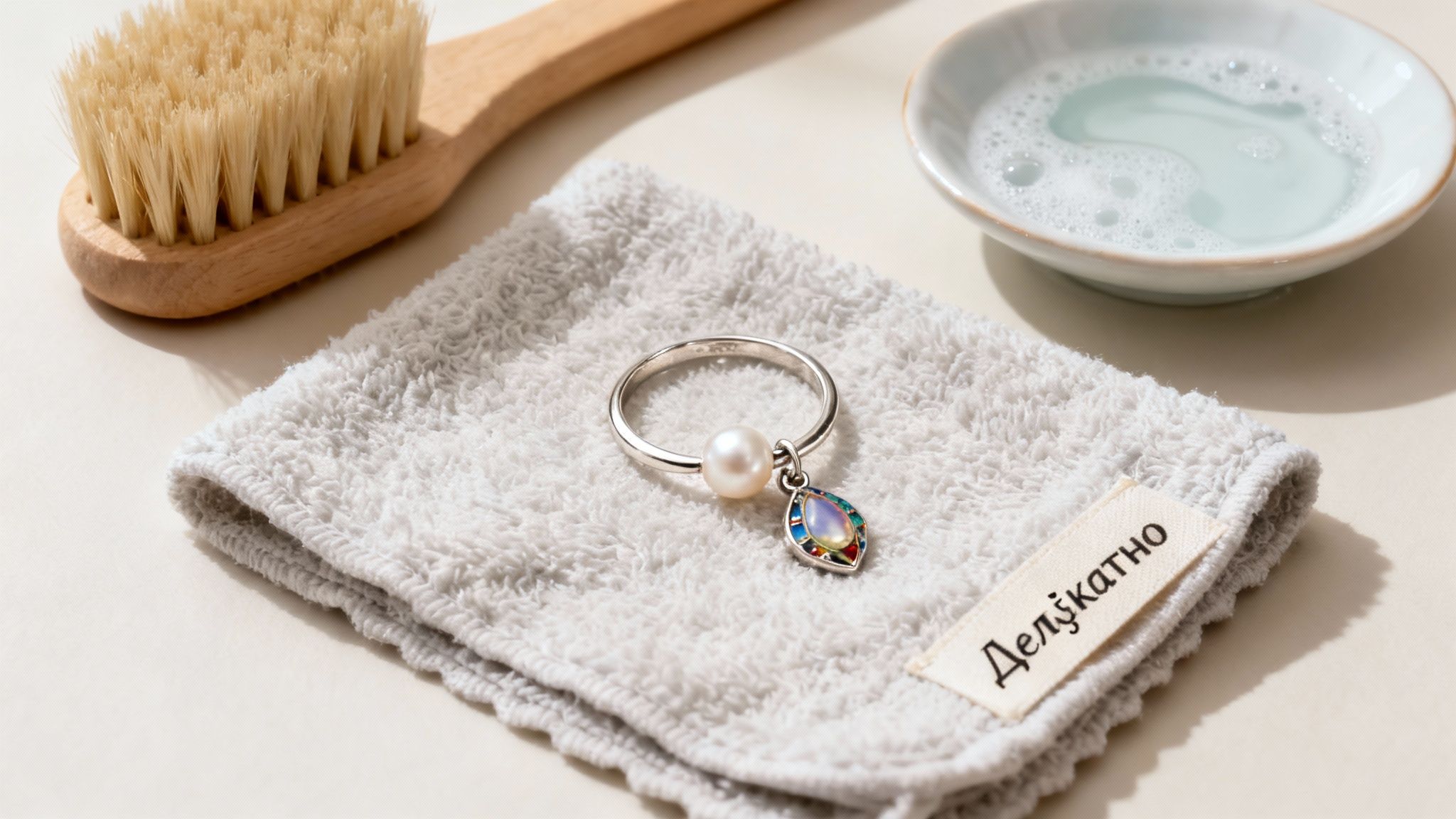
Jewelry with stones, pearls or enamel requires special care. What is perfect for metal can be destructive for a fragile insert. Forget about aggressive chemicals, abrasives or hot water.
Delicate care for organic inserts
The most sensitive are inserts of organic origin: pearls, coral, mother-of-pearl and amber. They are soft, porous and do not tolerate contact with chemicals.
- Pearls and mother-of-pearl: Their main enemy is acids and ammonia. Only wiping with a soft, slightly damp cloth is permissible, followed by immediate drying.
- Coral and Turquoise: The porous structure of these stones instantly absorbs grease and chemicals, causing irreversible discoloration. Dry cleaning only is recommended.
- Amber: This fossilized resin is very soft, scratches easily, and does not tolerate contact with alcohol.
The safest approach is spot cleaning. Using a cotton swab dipped in a mild soap solution, carefully clean the metal parts, avoiding the insert.
Modern jewelry practice is clear: if you are not sure, it is better to trust the professionals. You can read about the combination of tradition and modern recommendations in the overview of popular silver care methods .
Cleaning mineral stones and enamel
Jewelry with cubic zirconia, topaz, or amethyst, as well as those covered with enamel, is more durable, but also requires a delicate approach.
Cubic zirconia, zirconium and other hard stones
These crystals become dull due to a build-up of sebum and dust. You can restore their shine with a mild soap solution.
- Soak the jewelry in warm soapy water for 5-10 minutes .
- Use the softest child's toothbrush to gently scrub the stone.
- Rinse the product thoroughly and dry with a microfiber cloth.
This method is great for cleaning hard-to-reach places, which is especially important for earrings, such as earlobes .
Jewelry enamel
Enamel is a thin layer of glass fused to metal. It is fragile and resistant to shocks, temperature changes, and abrasives.
- Never clean enamel with powders, soda, or paste.
- To care for it, simply wipe it with a soft cloth dampened in cool water.
- Protect it from contact with perfumes and creams.
Rhodium-plated silver: a special case
Most modern silver jewelry has a rhodium coating, which protects the silver from tarnishing. Rhodium is resistant to chemicals, but its main enemy is friction.
Any abrasive substances (polishing pastes, soda) for such products are strictly prohibited.
How to clean rhodium-plated silver:
- Wash your jewelry only in warm soapy water.
- Use only soft fabrics such as microfiber.
- Never rub with force.
If the thin layer of rhodium is damaged, the silver underneath will begin to darken, and only a jeweler can restore the coating.
How to properly store silver so it doesn't tarnish
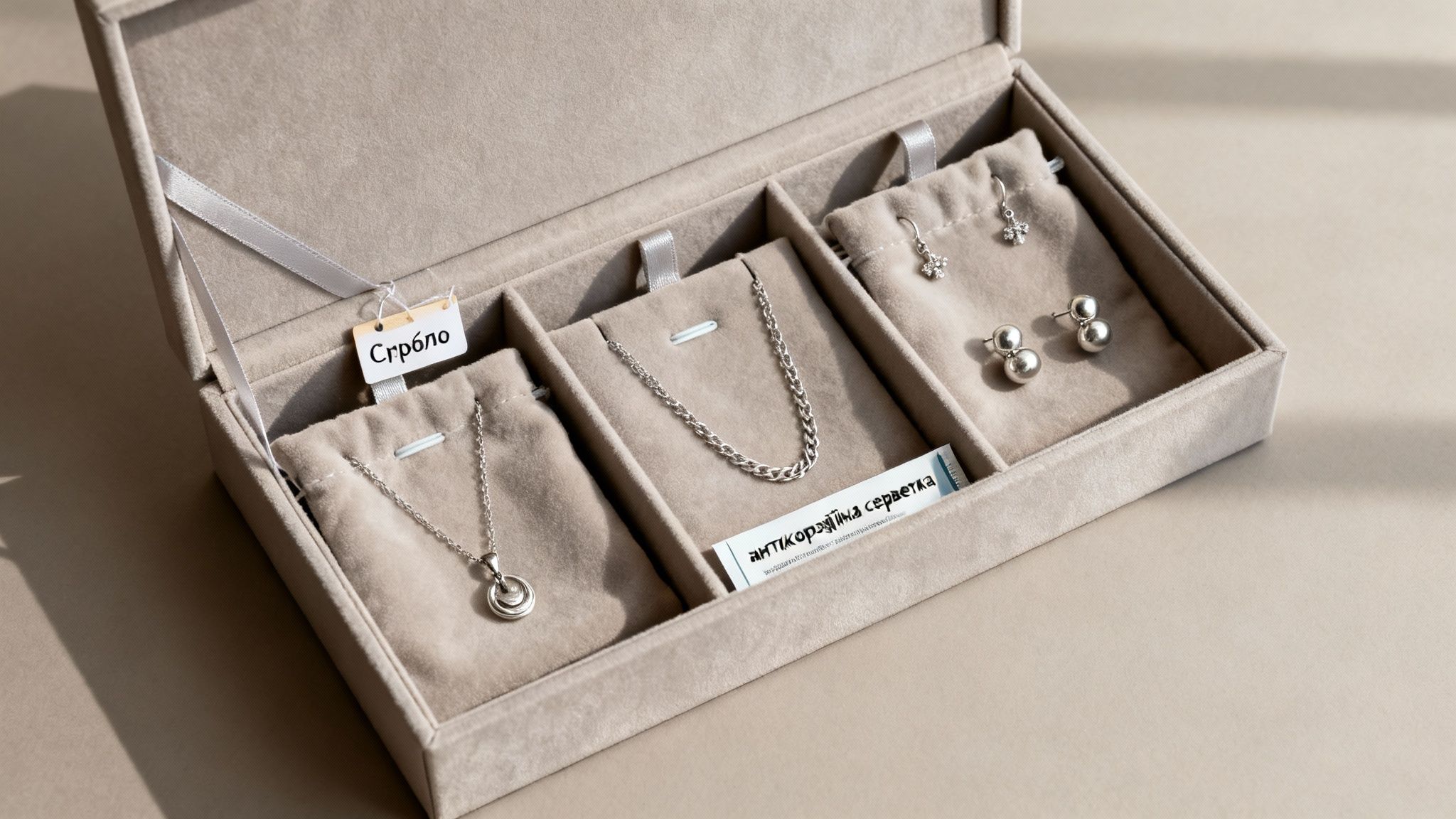
Competent prevention and proper storage can preserve the shine of jewelry for a long time. The main enemies of silver are moisture and air. Therefore, the main task is to isolate the products from these factors as much as possible.
We create ideal storage conditions
The ideal place for silver is a dry, dark, and cool place. The most effective option is to keep each piece of jewelry in a separate, air-tight bag or ziplock bag. This limits oxygen and protects against scratches.
For a large collection, the best solution would be a special box with soft interior padding and separate compartments.
Tip: Place a piece of chalk or a silica gel packet in the box. They absorb excess moisture, creating an optimal microclimate.
Special anti-corrosion wipes placed in the box create an additional protective barrier, neutralizing sulfur compounds. High-quality gift packaging for jewelry also often provides proper conditions for long-term storage.
Daily habits that save silver
The way you wear your jewelry affects its condition just as much as the way you store it.
The golden rule: "last to put on, first to take off"
Wear silver after applying all cosmetics, perfumes, and hairspray. The chemicals in them are powerful tarnish catalysts. When you get home, remove your jewelry first.
Situations when it is better for silver to "rest":
- Swimming pool or sauna. Chlorinated water and high humidity are the worst friends of silver.
- Gym: Sweat contains salts and sulfur, which cause darkening.
- Cleaning. Contact with household chemicals can permanently damage the jewelry.
- Cooking: Foods rich in sulfur accelerate the oxidation process.
Proper care is a comprehensive approach. A careful approach to storage and daily habits will allow your silverware to stay bright and shiny for much longer.
Answers to frequently asked questions about silver care
Here are answers to the most frequently asked questions that will help you avoid mistakes and keep your jewelry in perfect condition.
How often should silver jewelry be cleaned?
There is no universal graphic. Focus on the appearance of the product.
Jewelry that you wear every day may need a light polish every 1-2 weeks . A deep cleaning should be done every 1-2 months or at the first signs of tarnishing.
Tip: Don't wait until plaque becomes thick. Regular, light preventative care is always better than infrequent, aggressive cleaning.
The sooner you react to the darkening, the easier it will be to restore the shine to the jewelry.
Can rhodium-plated or gold-plated silver be cleaned using conventional methods?
No, not at all. These products require a much more delicate approach. Rhodium plating or gold plating is the thinnest layer of precious metal that can easily be erased.
What to avoid:
- Any abrasives: soda, toothpaste, polishing powders.
- Aggressive chemistry: concentrated solutions for cleaning silver.
- Strong friction: even hard fabric can leave micro-scratches.
The only safe method is a warm soapy solution and a soft microfiber cloth.
What to do if silver remains dark after cleaning?
If safe home methods do not help, this may indicate old plaque or chemical damage to the metal.
In such a situation, the best solution would be to stop experimenting and trust a professional jeweler. Workshops use ultrasonic baths and specialized polishing pastes that allow you to safely restore the jewelry to its original appearance.
Taking care of your jewelry is a manifestation of love for yourself and your belongings. The Taton.shop assortment offers exquisite silver products that, with proper care, will delight you for years. Check out our collection and choose the jewelry that best emphasizes your style.
