How to measure your finger size for a ring: a guide from Taton.shop
Determining your ring size seems like a simple task: a thread, a ruler, and you're done. However, this method most often leads to errors and the return of jewelry. The accuracy of measurement depends on nuances that are often ignored.
Key factors affecting accuracy
The perfect ring doesn't start with measuring, but with understanding that finger size is a dynamic variable. It changes. A few simple rules will help avoid mistakes and ensure a comfortable fit.
90% of measurement success depends on proper preparation. These are details that at first glance seem unimportant, but can change the result by a whole order of magnitude.
When is the best time to take measurements?
Our fingers react to the state of our bodies. They can be swollen in the morning due to fluid retention, just like after a workout, a long walk in the heat, or a plane flight.
You will get the most accurate results in the evening , when your body temperature is stable and daytime swelling has subsided. It is important to take measurements at a comfortable room temperature. Fingers contract in the cold, and expand in the heat.
To be absolutely sure, take several measurements at different times throughout the day and find the average. This is your most reliable guide.
Joint Anatomy: Why It's Important
A classic mistake is to measure only the base of the finger, ignoring the knuckle. If the knuckle is noticeably wider, the ring may simply not fit, even if the size is perfect at the base.
How to do it right:
- Measure the circumference of the base of the finger where the ring will sit permanently.
- Separately measure the circumference of the widest part of the joint.
- If the values differ, your ideal size is the arithmetic mean between them.
This approach ensures that the jewelry will easily pass through the joint but will not dangle at the base of the finger.
How ham width affects size
The width of the shank (the rim of the ring) directly affects the fit. The rule is simple: the wider the ring, the tighter it feels.
For massive models with a shank of 5 mm or more, we recommend choosing a size 0.25–0.5 mm larger than your usual size. A thin ring contacts the finger along a narrow line, while a wide one occupies a significant area, which creates a feeling of a tight fit. To better understand how the material affects the appearance, read our article about 925 silver .
Reliable home measurement methods
The lack of professional tools is not a sentence. Proven home methods, with the right approach, give accurate results. Let's consider the two most popular methods.
The key to success is attention to detail. Even the simplest method requires precision. An error of one millimeter can mean a difference of a whole size. Follow the recommendations and you will accurately determine your size.
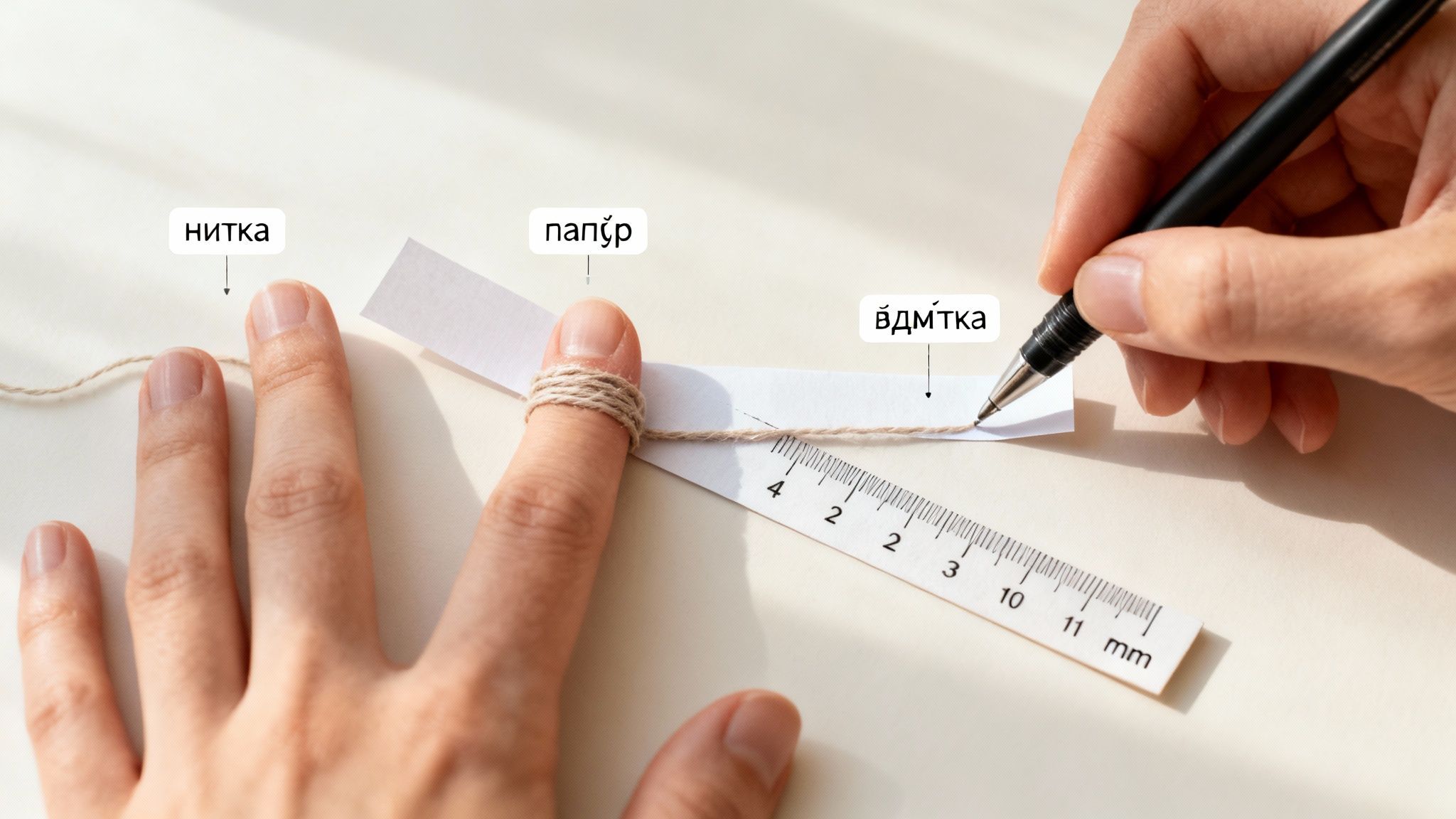
Using floss or dental floss
A classic method that has its own nuances. It is best to take a thick cotton thread that does not stretch. Even better - dental floss: it is strong and will not change its length under pressure.
How to act:
- Carefully wrap the thread around the base of your finger. It should fit snugly but not cut into the skin.
- Make sure the makeshift ring of thread goes through the joint. This is critical. If not, loosen it a little.
- Use a thin marker to mark where the end of the thread intersects with its main part.
- Unroll the thread and place it on a ruler. Measure the length from the beginning to the mark to the nearest millimeter. This is the circumference of your finger.
The resulting length in millimeters remains to be compared with the size chart.
Important: Do not use elastic or wool threads. They stretch easily and the result will be inaccurate.
Measuring with a paper strip
The paper method is considered more reliable than thread because paper better imitates the shank of a real ring and does not cut into the skin as much.
You will need a sheet of paper, scissors, a pen, and a ruler. Cut an even strip of paper 3-5 mm wide and about ten centimeters long.
Instruction:
- Wrap the paper strip around the base of your finger. It should fit comfortably: not loose or tight.
- Check to see if the paper ring passes through the joint. If it does, loosen the strip a little.
- Use a pen to mark where the edge of the paper overlaps the other part of the strip.
- Use a ruler to measure the distance from the beginning of the strip to your mark. This is the circumference of your finger.
The advantage of the method is that the width of the paper partially takes into account the fit of a standard-width ring.
Making corrections for accuracy
Home methods have a certain error. From the experience of jewelers, the deviation can be 0.8–1.2 mm of the inner circumference, which is equivalent to 0.5–1 size .
This means that a correction should be added to the results obtained with thread or paper: +0.5 mm for thin rings and +1.0–1.5 mm for wide models. You can learn more about trends in analytical reviews of the Ukrainian market .
This correction compensates for potential inaccuracy. It is always better to have a minimum margin than a ring that is too tight.
Using an existing ring as a reference
If you're unsure about threading methods, there's an easier and more reliable way. It's ideal if you already have a ring that fits perfectly on the finger you want to use. This method eliminates most problems, such as swelling or improperly tightened thread.
The main advantage is high accuracy. Using an existing piece of jewelry, you get a real, not a theoretical measurement, which significantly reduces the risk of making a mistake when ordering online.

Measuring the inner diameter
This is a classic method. All you need is your sample ring and a ruler. For maximum accuracy, it is better to use a caliper. The size of a ring in the Ukrainian system is its inner diameter in millimeters.
Place the ring on a flat surface. Place the ruler so that its zero mark is against the inside edge of the ring. Measure the distance to the opposite inside edge, making sure to cross the center of the circle.
Important: measure the inner diameter . Even a millimeter of error can mean a mistake in size. For example, if you got 17 mm , this is size 17.0 .
Nuances to pay attention to:
- Centered: Make sure the ruler passes through the widest part of the hole.
- Ring condition: Only use jewelry that is perfectly round. A deformed ring will not give an accurate result.
- Check: Take several measurements, turning the ring slightly each time.
This method is ideal if you are preparing a surprise and want to find out the size discreetly.
Modern approach: templates
Technology offers more convenient options - ready-made templates for printing. On the Internet, you can find PDF files with circles of various diameters that correspond to standard sizes.
How to work with a printed template:
- Find and download the template with the circles as dimensions.
- Print it. In the print settings, set the scale to 100% .
- After printing, check the scale with a ruler by placing it against the reference mark on the template.
- Place your ring against the circles until you find one that perfectly matches its inner contour.
Although this method is simple, it requires attention. Incorrect printing scale can distort the result.
An important nuance: the shape and width of the ham
Even after measuring the diameter perfectly, consider the design. The design features of the new ring can affect the fit.
For example, the shape of the shank. Rings with a flat inner profile (flat) fit more tightly than models with a rounded (comfort fit). If your reference ring is a comfort fit, and you buy a model with a flat profile, you should consider a size 0.25-0.5 mm larger.
And, of course, width. If your ideal ring has a thin shank ( 2-3 mm ), and you choose a massive one ( 6 mm wide or more) - feel free to take a half size larger. Explore the range in our Taton.shop ring collection to understand how design affects fit.
International size charts
So, you have measured your finger and have specific numbers. Now you need to convert them to a standardized size. This is where the nuances begin, because there is no single measurement system. The size grids in Ukraine, the USA or the UK are radically different.
Understanding these differences is your insurance against unsuccessful purchases, especially when ordering online.
How to decipher the size chart
A conversion chart is your jewelry dictionary. It links physical measurements to codes accepted in different countries.
In Ukraine and most European countries, everything is logical: the size of the ring is its inner diameter in millimeters . If the diameter is measured as 17 mm, your size is 17.0.
In other countries it is more difficult:
- USA and Canada: numerical scale from 3 to 13+, often with half values (6.5).
- Great Britain and Australia: a system based on the letters of the Latin alphabet - from A to Z, also with half sizes (J 1/2).
This confusion is easily resolved with a pivot table.
Ring size conversion table
So that you can quickly determine your size on any scale, we have prepared a convenient comparison table.
| Inner diameter (mm) | Size Ukraine / EU | US & Canada size | UK & Australia size |
|---|---|---|---|
| 15.7 | 15.7 | 5 | J 1/2 |
| 16.1 | 16.1 | 5.5 | K 1/2 |
| 16.5 | 16.5 | 6 | L 1/2 |
| 16.9 | 16.9 | 6.5 | M 1/2 |
| 17.3 | 17.3 | 7 | No. 1/2 |
| 17.7 | 17.7 | 7.5 | About 1/2 |
| 18.1 | 18.1 | 8 | P 1/2 |
| 18.5 | 18.5 | 8.5 | Q1/2 |
| 19.0 | 19.0 | 9 | R 1/2 |
| 19.4 | 19.4 | 9.5 | S 1/2 |
| 19.8 | 19.8 | 10 | T 1/2 |
| 20.2 | 20.2 | 10.5 | U 1/2 |
For absolute certainty, you can download a convenient size chart from Taton.shop - it will become your reliable assistant.
Note from an expert: In Ukraine, jewelers focus on the inner diameter. The average female size is 16.0-17.0 , which corresponds to a finger circumference of 52–56 mm . This helps to navigate when choosing a gift.
How to discreetly find out the ring size for a gift
Choosing a ring for someone is a personal moment. The main challenge is to keep it a surprise. There are a few proven ways to find out the size without giving away your identity.
The easiest method is to use a piece of jewelry that the person is already wearing. If you can "borrow" a ring from the desired finger for a few minutes, measure its inner diameter - the resulting value will be your Ukrainian size.
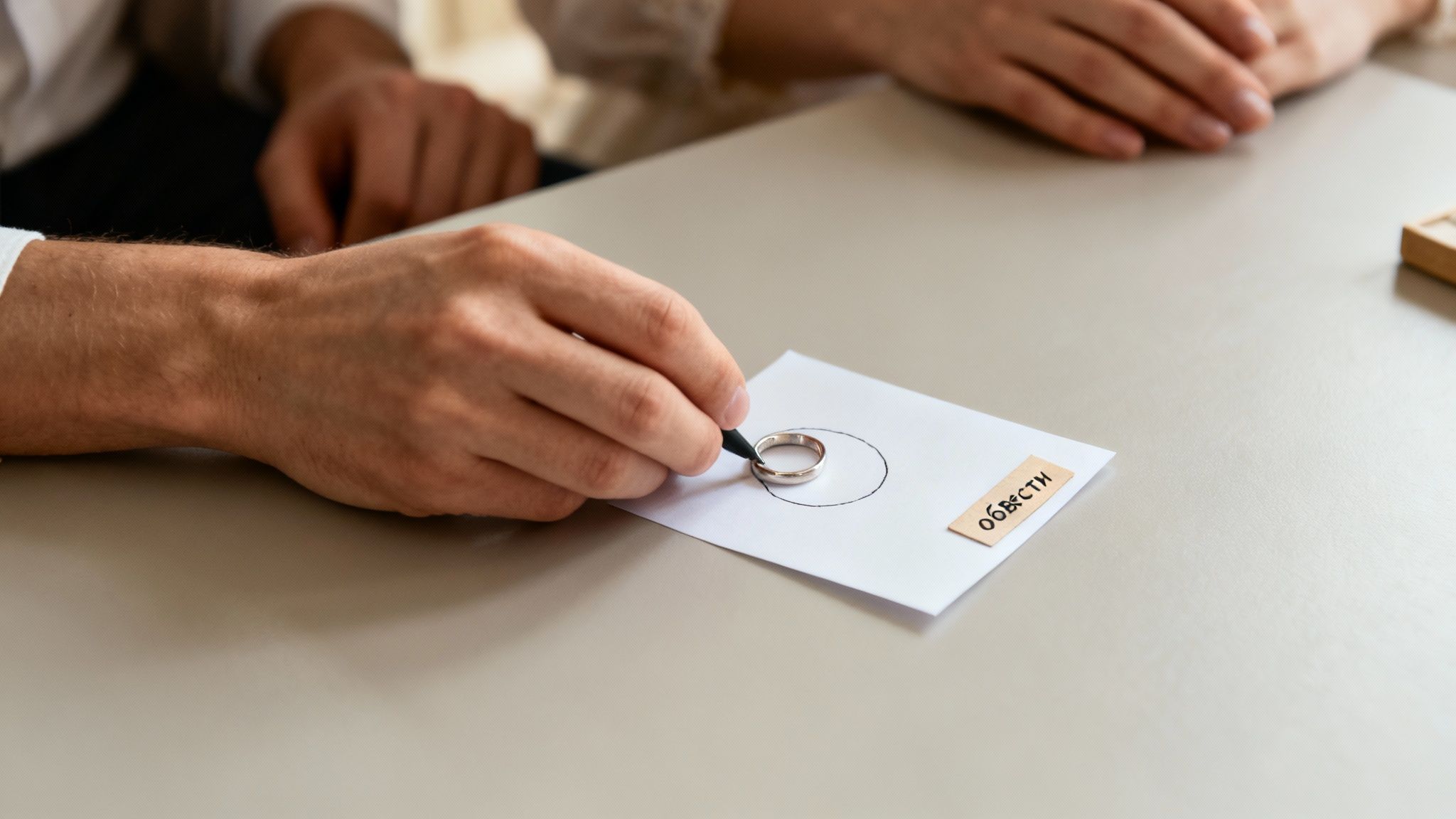
The "borrowed" ring strategy
No way to take the jewelry? No problem. There are other accurate options.
Trace the ring on paper. Place it on the sheet and use a finely sharpened pencil to trace the inner outline . Make a few drawings to be sure. Then measure the diameter of the resulting circle.
Another approach is to make an impression. Take a piece of modeling clay or soft soap. Gently press the ring against it. You will have a clear impression that can be measured.
Engaging allies
Sometimes the best way is to ask for help. Friends or family can become your allies.
A classic option is to go shopping together. Ask your friend to drag your chosen one to a jewelry store under the pretext of choosing a gift for herself. During a “random” fitting, you can easily find out the right size.
If you have to act alone, show your acting skills. You can buy an inexpensive jewelry ring and jokingly offer to try it on. This will give you a rough idea of the range.
Plan B if in doubt
Even after all the tricks, you may not be 100% sure. That's normal. In such a situation, it's worth considering models that leave room for maneuver.
What you can choose:
- Adjustable rings. Open models are the perfect solution. They are easy to adjust to your finger.
- Thin models. Narrow rings (up to 3 mm ) sit more freely. A small error of 0.25-0.5 mm will not be critical here.
- Gift certificate. Will allow a person to independently choose the perfect jewelry for themselves.
If you've settled on a fixed ring size but are hesitating between two adjacent sizes, always choose the larger one . It's easier to have a ring made smaller at a jeweler than it is to have it made larger. If you're lacking inspiration, take a look at our gift ideas for your girlfriend .
Remember, the most important thing in a gift is your attention.
When is it time to trust a professional?
Home measurements are convenient, but they don't always guarantee accuracy. There are times when a visit to a jewelry shop is a necessity. A professional works with specialized tools that leave no room for error.
When it comes to expensive or symbolic jewelry, such as an engagement ring, saving time can be costly. Consulting a professional is your guarantee of comfort.
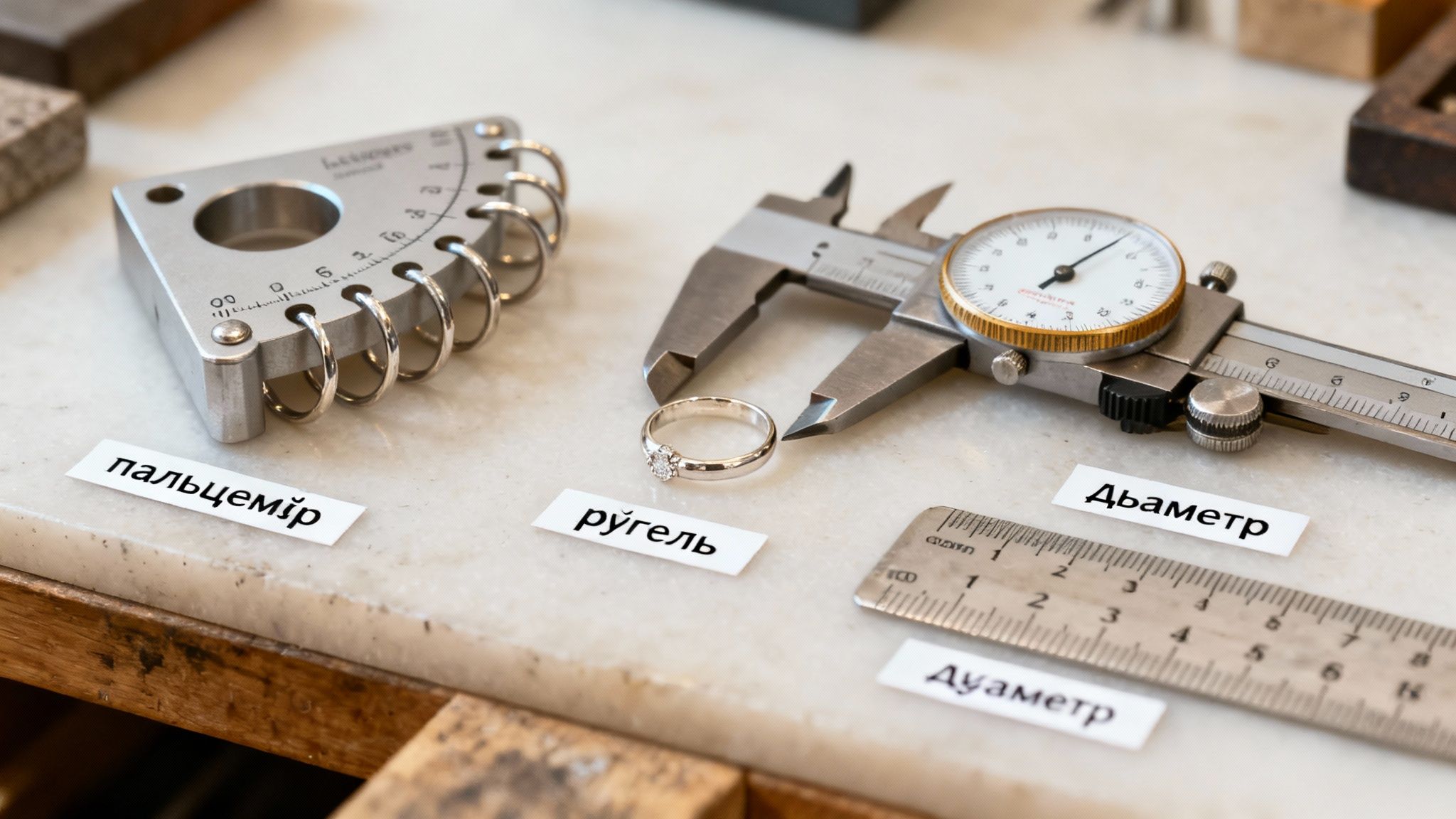
Tools that guarantee accuracy
There are two indispensable tools in a jeweler's arsenal.
A ring gauge is a set of metal rings that vary in diameter in 0.25 or 0.5 mm increments. You try them on until you find the perfect fit. This method allows you to get a feel for how the ring will actually fit.
A ring gauge (ring gauge cone) is a smooth metal cone with markings. A finished ring is placed on it to instantly determine its exact size.
According to suppliers, 71% of workshops consider finger gauges to be the “gold standard.” Their accuracy is as low as ±0.3 mm , which is virtually error-free. In comparison, home methods give an error of up to ±1.0 mm .
Four situations for a visit to a jeweler
While home instructions are useful, there are times when it's not worth the risk.
- Choosing a wedding or engagement ring. These are pieces of jewelry you will wear for years. Comfort is a priority here.
- Non-standard finger structure. If the joints are much wider than the phalanx, only a professional can help you find the right size.
- Buying an expensive piece of designer jewelry. When you invest a significant amount of money, the accuracy of the size becomes part of the cost.
- This is your first ring. A consultation will help you determine not only the size, but also the comfortable width and shape of the ring.
If in doubt, trust the experience of the master. This is the best investment in your comfort. If you have any questions during the selection process on our website, contact our consultants via the Taton.shop contact page .
Frequently asked questions about choosing a size
Even after careful measurements, buying online can leave room for doubt. That's normal. We've collected answers to the most frequently asked questions from our customers.
What if my size is in the middle?
Classic situation: the measurement showed something between 16.5 and 17. This is where the ring design comes into play, namely the width of the shank.
For thin models up to 3 mm wide, choose a smaller size. For massive, wide rings (from 5 mm ), the rule is the opposite - always choose a larger size.
Are the fingers on the right and left hands the same?
No. The fingers on your dominant hand (usually your right hand if you're right-handed) are slightly larger due to better muscle development. The difference may seem insignificant, but it's often half a size.
Important: Always measure the finger you plan to wear the ring on. Do not use a similar finger on the other hand.
How do weather and time of day affect measurements?
Our fingers change. In the summer, in the heat or towards evening, they tend to swell. In the morning or in the cold, they become thinner.
The best time to take a measurement is in the evening , when you are relaxed and in a room with a comfortable temperature.
I made a mistake with the size on taton.shop. What now?
We understand that it's difficult to guess the perfect size online. Taton.shop has a simple exchange policy. If the ring doesn't fit, you have 14 days to contact our support team and request a replacement.
We hope this guide has given you confidence. Now you are armed with the knowledge to choose your perfect piece of jewelry at Taton.shop .
